Fly inside FastAPI Cloud




Episode Deep Dive
Guests
This episode features four members of the FastAPI Cloud team:
Sebastian Ramirez (Tiangolo) -- Creator of FastAPI, the Python web framework that has become the most-starred backend framework on GitHub across all languages (nearly 95,000 stars). Sebastian is also known for his viral tweet about a job posting requiring five years of FastAPI experience when he had only created the framework 2.5 years prior. He is the founder of FastAPI Labs, the company behind FastAPI Cloud, backed by Sequoia Capital.
Patrick Arminio -- Creator of Strawberry, a popular Python library for building GraphQL APIs. Patrick is also an organizer of PyCon Italy and a former EuroPython organizer. At FastAPI Cloud, he leads integrations and CLI tooling work.
Savannah Ostrowski -- A CPython core developer, member of the Python Steering Council for 2026, and the release manager for Python 3.16 and 3.17. She works on the CPython JIT, argparse, and other areas of CPython. At FastAPI Cloud, she brings deep Python ecosystem expertise and previously worked on cloud tooling at other companies.
Jonathan Ehwald -- A backend and infrastructure engineer at FastAPI Cloud. He joined the team after EuroPython and focuses on Kubernetes controllers, build caching, deployment internals, and performance optimization. He is the author of the open-source
fastarlibrary for fast tar archive handling in Python, powered by Rust.
What to Know If You're New to Python
- FastAPI is one of the most popular Python frameworks for building web APIs and backends. It uses Python type hints to provide automatic data validation, serialization, and interactive API documentation. Understanding the basics of how web APIs work (routes, requests, responses) will help you get the most out of this episode.
- uv is a modern, extremely fast Python package and project manager written in Rust. It replaces tools like pip, virtualenv, and pipx. Several commands in this episode reference
uvx(which runs tools without installing them globally), so knowing that uv exists and what it does will be helpful context. - Deployment refers to taking code that runs on your local machine and making it available on the internet for others to use. Much of this episode discusses the complexity of cloud deployment and how FastAPI Cloud aims to simplify it to a single command.
Key Points and Takeaways
1. FastAPI Cloud: One-Command Deployment for Python Developers
FastAPI Cloud is a new deployment platform built by the creators of FastAPI that reduces deploying a FastAPI application to a single command: fastapi deploy. The platform handles HTTPS, auto-scaling, builds, and infrastructure so developers can focus entirely on writing application code. Sebastian described it as "the equivalent of what FastAPI is to building web APIs" -- just as FastAPI simplified API development, FastAPI Cloud aims to simplify deployment. The product is currently in private beta with a waiting list, and the team is actively onboarding users.
- fastapicloud.com -- FastAPI Cloud website and waiting list
- fastapi.tiangolo.com -- FastAPI framework documentation
2. A "Pythonic" Cloud Experience
The team discussed how they are deliberately trying to make FastAPI Cloud feel "Pythonic" -- not just simple, but specifically aligned with the sensibilities and expectations of Python developers. Jonathan described this as "choosing a particular flavor of simple" that transfers the Pythonic ethos from libraries and coding style to the cloud experience. Savannah emphasized that the platform is "bespoke for Python developers," integrating with modern tooling like uv rather than being a generic cloud platform that also happens to support Python. This focus on Python-native ergonomics is a distinguishing factor from broader cloud providers like AWS, Azure, or Vercel.
3. The fastapi new Scaffolding Command
Savannah built a CLI command called fastapi new (run via uvx fastapi-new) that scaffolds a complete FastAPI project from scratch. It creates the folder structure, installs dependencies using uv, and generates a basic FastAPI application ready to deploy. This is especially useful for beginners and educators who want to go from zero to a working, deployable application without worrying about project setup. For developers who already have an existing FastAPI app, the scaffolding step is entirely optional -- they can go straight to fastapi deploy.
- pypi.org/project/fastapi-cli -- FastAPI CLI on PyPI (includes fastapi-new as an optional dependency)
4. Broad Package Manager Support: uv, pylock.toml, and requirements.txt
FastAPI Cloud supports multiple dependency management formats. The primary and recommended experience uses uv with uv.lock files, but the platform also supports pylock.toml (the new PEP 751 standard lock file format championed by Brett Cannon), plain requirements.txt, and any package manager that uses the standard pyproject.toml format (such as PDM or recent versions of Poetry). Sebastian noted that uv users will have "the best experience" since the team are self-described fans, but the goal is to meet developers wherever they are in their tooling choices.
- github.com/astral-sh/uv -- uv: extremely fast Python package manager written in Rust
- peps.python.org/pep-0751 -- PEP 751: pylock.toml standard lock file format
5. The "Bus Ticket Factor": A New Way to Think About Open Source Sustainability
Sebastian introduced a reframing of the well-known "bus factor" concept. Rather than worrying about how many maintainers a project has, he encouraged listeners to think about the "bus ticket factor" -- who is paying for the bus tickets? In other words, what value are the people maintaining a project receiving in exchange for their work? He pointed out that even large companies like Google, Amazon, and Meta cancel products despite having massive teams, so headcount alone does not determine sustainability. The real question is whether there is a sustainable incentive -- financial, personal, or otherwise -- for maintainers to keep investing in the project. FastAPI Cloud provides that alignment: the more successful FastAPI (and Python) are, the more potential customers FastAPI Cloud has.
6. Commercial Open Source Done Right: How FastAPI Cloud Strengthens FastAPI
A significant portion of the conversation addressed how the commercial FastAPI Cloud venture gives back to the open-source FastAPI project. The team actively dogfoods FastAPI, SQLModel, and related libraries internally, which means bugs get found and fixed faster, leading to more frequent releases. Savannah noted that her employer values and supports her open-source CPython contributions, including her Steering Council and release management work. Sebastian emphasized that the incentive alignment is financial, not just principled: FastAPI's success drives FastAPI Cloud's potential, so investing in the open-source project is inherently good for the business. FastAPI has over 7,000 forks, making it essentially un-disappearable as open source.
- github.com/fastapi/fastapi -- FastAPI on GitHub (94.9k+ stars)
- sqlmodel.tiangolo.com -- SQLModel: SQL databases in Python with type hints
7. Kubernetes Under the Hood with Auto-Scaling to Zero
Jonathan revealed that FastAPI Cloud is built on Kubernetes at its foundation, with standard cloud providers underneath that. On top of Kubernetes, the team has built custom controllers (written in Go) and additional infrastructure to handle the complexity that users never have to see. A standout feature is request-based auto-scaling, including the ability to scale down to zero when no traffic is coming in. This is not the same as AWS Lambda -- the full container with all dependencies runs as a complete application, but the platform dynamically adjusts the number of replicas based on incoming requests, potentially saving users significant costs compared to always-on infrastructure.
8. fastar: An Open-Source Rust-Powered Library Born from Internal Needs
Jonathan open-sourced fastar, a Rust-backed Python library for compressing and decompressing tar archives that serves as a near drop-in replacement for Python's standard tarfile module but runs significantly faster. The library was born out of FastAPI Cloud's deployment pipeline, where shaving seconds off archive operations during builds made a meaningful difference. This exemplifies the team's philosophy of building internal tools as separate, well-structured packages and open-sourcing them when they are ready. Sebastian noted that the team has open-sourced (or plans to open-source) several internal tools, including authentication/authorization libraries and CLI tooling.
- pypi.org/project/fastar -- fastar on PyPI: high-performance tar archive handling backed by Rust
9. Integrations: Supabase, Hugging Face, Logfire, Redis, and More
The team discussed their approach to third-party integrations. Current and upcoming integrations include Supabase (Postgres as a service), Hugging Face (AI/ML models), Pydantic Logfire (observability), Redis, and potentially MongoDB. Patrick explained that integrations go beyond simply setting environment variables -- the goal is deep integration where, for example, creating a pull request preview deployment could automatically create a corresponding Supabase database branch. The team is not hosting databases themselves but instead connecting with best-in-class external providers through OAuth and API integrations.
- supabase.com -- Supabase: the Postgres development platform
- pydantic.dev/logfire -- Pydantic Logfire: observability platform
- huggingface.co -- Hugging Face: AI model hub and platform
10. The Impact of AI on Documentation-Driven Businesses
Michael raised the cautionary tale of Tailwind CSS, whose npm downloads are up six times year over year while revenue is down five times. The reason: AI tools can generate Tailwind code directly without users visiting the documentation site, where they would discover premium offerings. The group discussed how FastAPI Cloud is in a different position because it provides ongoing operational value (hosting, scaling, security) that AI cannot replace. Jonathan noted that AI could theoretically maintain infrastructure someday, but "it's just too hard at the moment," and what FastAPI Cloud really sells is responsibility -- shifting the risk and operational burden from the developer's team to theirs.
11. Python Performance: The Specializing Adaptive Interpreter and Beyond
Savannah and Michael touched on the significant performance improvements in recent Python versions. The specializing adaptive interpreter, introduced around Python 3.11, has been a major factor in making Python faster. Savannah also mentioned her work on the CPython JIT compiler. Michael noted that Python 3.9 through 3.11 did foundational work that "uncorked a lot of innovation" in Python's runtime performance. Savannah also observed that Python is the language used most in AI-generated code, adding a new dimension to Python's continued relevance and growth.
12. The Cult.Repo FastAPI Documentary
Michael gave a shout-out to the Cult.Repo (formerly Honeypot) documentary on FastAPI called "The Rise and Rise of FastAPI." The same production team behind the official Python documentary created this approximately 10-minute mini documentary about FastAPI's origin story. Sebastian shared that the Cult.Repo team reached out to him while they were still producing their Python documentary trailer, asking to include FastAPI in their series of framework documentaries. The production quality was praised as excellent.
- cultrepo.com -- Cult.Repo: open source developer documentaries
13. Custom Domains and the Roadmap Ahead
Michael asked about custom domain support, which is actively being developed by Jonathan. Patrick added that for DNS providers that support OAuth, the team aims to enable one-click domain setup, automatically handling DNS records and certificate provisioning. The platform is currently in private beta with thousands of people on the waiting list. Sebastian noted that they manually review waiting list submissions, looking at use cases and team sizes, and that providing detailed information about what you plan to build increases the chances of being admitted sooner. Future plans include supporting more Python frameworks beyond FastAPI and expanding based on user feedback gathered through their GitHub issues repo and community Slack.
14. Education and the Value of Quick Iteration Cycles
Both Michael and Savannah highlighted how FastAPI Cloud could be a game-changer for Python education. In coding bootcamps, university classes, and corporate training sessions, setting up deployment infrastructure is a time-consuming distraction from the actual curriculum. Savannah pointed out that "setting up the environment for them to deploy is not part of it -- it's this peripheral thing that ends up eating up a bunch of the educator's time." With fastapi deploy, students can go from a working local app to a live internet deployment in seconds, creating a powerful "aha moment" that motivates further learning.
Interesting Quotes and Stories
"It's one command. It's fastapi deploy. And you have a FastAPI app, you just hit fastapi deploy, and then it's on the cloud. We take care of everything." -- Sebastian Ramirez
"I saw a job post asking for five years of experience with FastAPI and I only had 2.5 since I created the thing." -- Sebastian Ramirez, on his viral meme about tech recruiting
"If you make a cloud, how do we make it feel Pythonic? Like what does that mean in a cloud setting? We talk about Pythonic libraries and coding style in the community a lot, and now we kind of try to transfer that flavor, that feeling, to the cloud." -- Jonathan Ehwald
"Every time people talk about the bus factor, I would like people to think about the bus ticket factor -- who is paying for those tickets?" -- Sebastian Ramirez
"I don't have to fight the open source battle at FastAPI Cloud. I think that's really cool." -- Savannah Ostrowski, on working at a company that values her open-source CPython contributions
"Some of us don't even get to write Python anymore to make all of this happen. I'm taking one for the team." -- Jonathan Ehwald, on writing Go for Kubernetes controllers so Python developers can have a simple experience
"Building Python tooling is kind of like taking one for the team sometimes, because you have these folks that are brand new to Python. Python is an extremely approachable language for people who are new to writing code. But then we also want to make FastAPI Cloud work for someone that's building an enterprise-grade application." -- Savannah Ostrowski
"Stack Overflow had as many questions asked this month as they did in the first month of their existence -- three or four thousand, whereas at their peak, they were 200,000 questions a month." -- Michael Kennedy, on the impact of AI on developer Q&A
Key Definitions and Terms
Bus Factor -- A measure of risk in a project: how many team members would need to be unavailable (metaphorically "hit by a bus") before the project stalls. A bus factor of one means a single person's departure could halt progress.
Bus Ticket Factor -- Sebastian's reframing of the bus factor concept, focusing on the sustainability question: what incentives (financial, personal, or strategic) keep the maintainers investing their time and energy in the project?
Dogfooding -- The practice of using your own product internally. FastAPI Cloud is built on FastAPI and SQLModel, so bugs found internally get fixed and released to the open-source community.
Scale to Zero -- An auto-scaling feature where the number of running application instances can drop to zero when there is no incoming traffic, reducing costs. The application spins back up when new requests arrive.
pylock.toml (PEP 751) -- A new Python standard for lock files, providing a reproducible, human-readable format for recording exact dependency versions. Championed by Brett Cannon and accepted in 2025.
Private Beta -- A pre-release phase where a limited number of users are granted access to test the product and provide feedback before a public launch.
Platform as a Service (PaaS) -- A cloud computing model where the provider manages the underlying infrastructure (servers, networking, scaling), allowing developers to focus solely on their application code.
Learning Resources
Here are resources to learn more about the topics discussed in this episode and go deeper with your Python and FastAPI skills.
Modern APIs with FastAPI and Python: Learn everything you need to build APIs with FastAPI, including type hints, async/await, data validation with Pydantic, and deploying to a cloud server. This course covers the core FastAPI concepts discussed throughout this episode.
Full Web Apps with FastAPI: Go beyond APIs and build full HTML web applications with FastAPI, including templates, static files, and everything you need for a complete web presence -- exactly the kind of apps you would deploy to FastAPI Cloud.
Python for Absolute Beginners: If you are new to programming or Python, this course starts from the very beginning and builds your foundation step by step -- the perfect starting point before diving into frameworks like FastAPI.
Async Techniques and Examples in Python: FastAPI is built on async Python. This course covers the full spectrum of Python's async and parallel programming capabilities, from async/await and asyncio to threads and multiprocessing.
Rock Solid Python with Python Typing: FastAPI relies heavily on Python type hints for data validation and documentation. This course teaches you the ins and outs of Python typing, including Pydantic and FastAPI-specific patterns.
Overall Takeaway
FastAPI Cloud represents a compelling new chapter for the FastAPI ecosystem -- one where the simplicity that made FastAPI beloved for building APIs is now being extended to deployment itself. What stands out most from this conversation is the deep alignment between the open-source project and the commercial product: every improvement to FastAPI Cloud feeds back into FastAPI, and every new FastAPI user is a potential cloud customer. The team's passion is palpable, from Savannah's dual commitment to CPython and cloud tooling, to Jonathan's willingness to write Go so Python developers never have to think about Kubernetes, to Sebastian's thoughtful reframing of open-source sustainability through the "bus ticket factor." For Python developers tired of the ever-growing complexity of cloud deployment, FastAPI Cloud promises something refreshingly Pythonic: just run one command and get back to building.
Links from the show
Sebastián Ramírez: github.com
Savannah Ostrowski: github.com
Patrick Arminio: github.com
Jonathan Ehwald: github.com
FastAPI labs: fastapilabs.com
quickstart: fastapicloud.com
an episode on diskcache: talkpython.fm
Fastar: github.com
FastAPI: The Documentary: www.youtube.com
Tailwind CSS Situation: adams-morning-walk.transistor.fm
FastAPI Job Meme: fastapi.meme
Migrate an Existing Project: fastapicloud.com
Join the waitlist: fastapicloud.com
Talk Python CLI
Talk Python CLI Announcement: talkpython.fm
Talk Python CLI GitHub: github.com
Command Book
Download Command Book: commandbookapp.com
Announcement post: mkennedy.codes
Watch this episode on YouTube: youtube.com
Episode #536 deep-dive: talkpython.fm/536
Episode transcripts: talkpython.fm
Theme Song: Developer Rap
🥁 Served in a Flask 🎸: talkpython.fm/flasksong
---== Don't be a stranger ==---
YouTube: youtube.com/@talkpython
Bluesky: @talkpython.fm
Mastodon: @talkpython@fosstodon.org
X.com: @talkpython
Michael on Bluesky: @mkennedy.codes
Michael on Mastodon: @mkennedy@fosstodon.org
Michael on X.com: @mkennedy
Episode Transcript
Collapse transcript
00:00 You've built your FastAPI app. It's running great locally. Now you want to share it with the world.
00:05 But then reality hits. Containers, load balancers, HTTPS certificates, cloud consoles with 200
00:12 options. What if deploying was just one command? That's exactly what Sebastian Ramirez and the
00:18 FastAPI cloud team are building. On this episode, we sit down with Sebastian, Patrick Arminio,
00:24 Savannah Ostrowski, and Jonathan Ewald to go inside FastAPI cloud, explore what it means
00:30 to build a Pythonic cloud and dig into how this commercial venture is actually making FastAPI,
00:35 the open source project, stronger than ever. This is Talk Python To Me, episode 536, recorded January
00:42 13th, 2026. Talk Python To Me, yeah, we ready to roll. Upgrading the code, no fear of getting old.
00:51 Async in the air, new frameworks in sight, geeky rap on deck. Quark crew, it's time to unite. We
01:01 Welcome to Talk Python To Me, the number one Python podcast for developers and data scientists.
01:06 This is your host, Michael Kennedy. I'm a PSF fellow who's been coding for over 25 years.
01:12 Let's connect on social media. You'll find me and Talk Python on Mastodon, Bluesky, and X.
01:17 The social links are all in your show notes. You can find over 10 years of past episodes at
01:23 Talk Python.fm. And if you want to be part of the show, you can join our recording live streams.
01:27 That's right, we live stream the raw uncut version of each episode on YouTube.
01:32 Just visit talkpython.fm/youtube to see the schedule of upcoming events.
01:36 Be sure to subscribe there and press the bell so you'll get notified anytime we're recording.
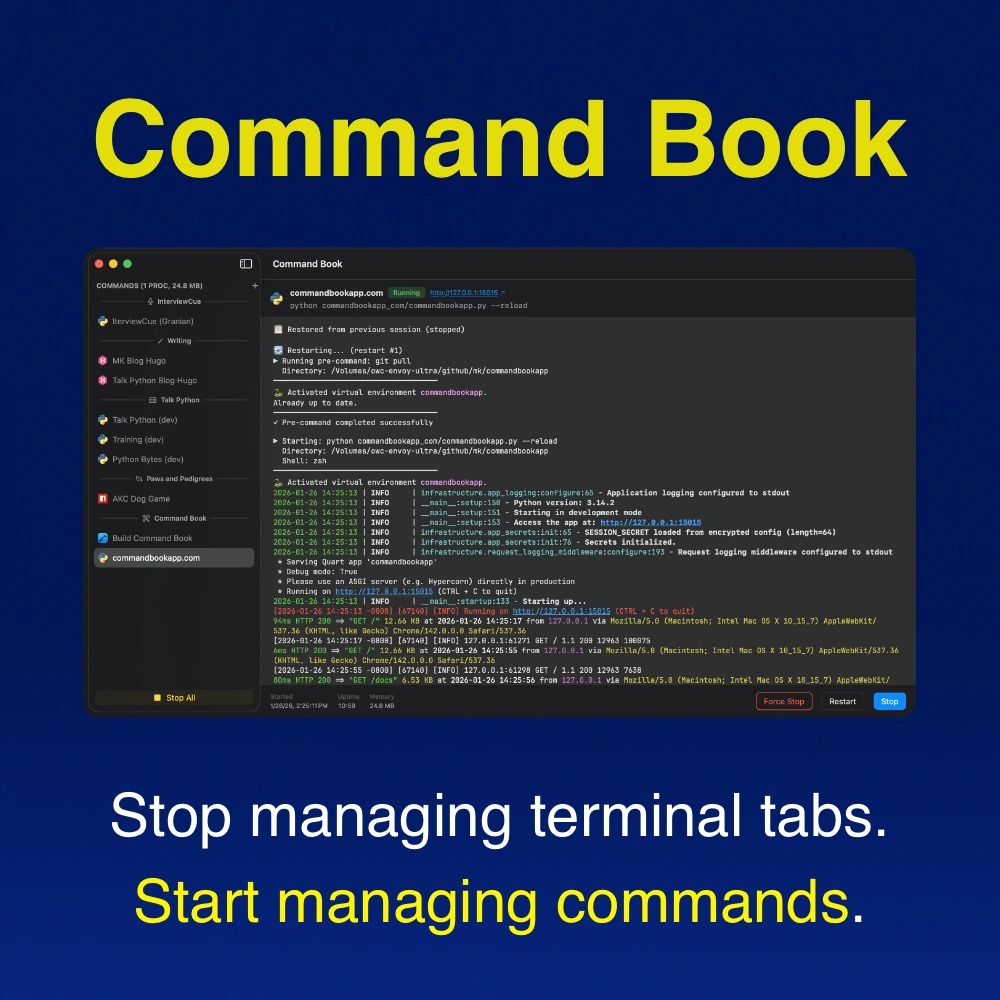
01:41 This episode is brought to you by CommandBook, a native macOS app that I built that gives
01:46 long-running terminal commands a permanent home.
01:49 No more juggling six terminal tabs every morning.
01:51 Carefully craft a command once, run it forever with auto-restart, URL detection, and a full CLI.
01:56 Download it for free at talkpython.fm/command book app.
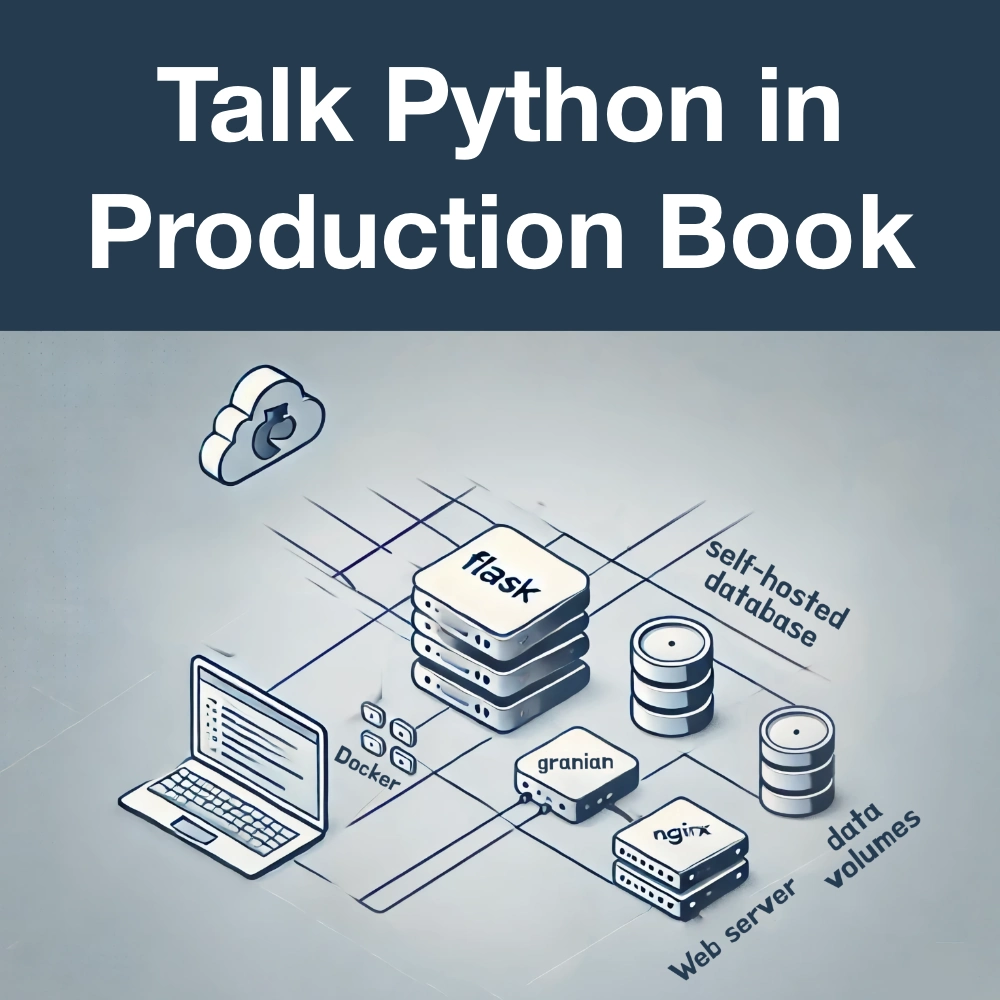
02:00 And it's brought to you by the Talk Python in Production Book,
02:03 an inside look at 10 years of the real-world DevOps behind the Talk Python sites and apps.
02:08 Check it out at talkpython.fm/DevOps book.
02:12 Before we dive in, I have something excellent to announce.
02:14 A few episodes back, I told you about our new AI integrations,
02:18 the Talk Python MCP servers, and our llms.txt file, so that AI tools can tap into our over 550 episodes and 7.5 million words of info around the Python community and history.
02:32 Well, I'm building on that now.
02:34 Talk Python now has an open source CLI tool.
02:37 You can search episodes, transcripts, guests, and even our courses right from your terminal.
02:42 No browser required.
02:44 It's fast too, backed by our optimized APIs, taking about five milliseconds of response time,
02:49 plus, you know, whatever the internet ping time is.
02:51 It supports rich text for humans, JSON for programs, and markdown output for AIs.
02:57 You just install it with uvtoolinstall talk-python-cli, and check it out on GitHub.
03:04 The link is in the podcast player show notes.
03:07 I also wrote up a blog post on the hows and whys of it.
03:09 Check that out over on the Talk Python blog at, well, talkpython.fm/blog.
03:14 The full link to the exact article is in the show notes.
03:17 All right, let's jump in.
03:20 Hello, everyone.
03:21 Sebastian, Patrick, Savannah, and Jonathan.
03:24 Awesome to have you all here.
03:26 Excited to talk about FastAPI Cloud.
03:28 Welcome.
03:28 Yes.
03:28 Thanks for having me.
03:29 Thank you.
03:30 We're also ahead, Mike.
03:31 What a project.
03:32 It's been going on for a while.
03:34 I've heard stuff from Sebastian that maybe something was brewing and all these things,
03:40 but not too long ago, you all announced it.
03:43 And I heard that FastAPI, some people have been using it recently.
03:47 Some of the surveys show that some people use it for websites.
03:51 I'm not sure.
03:51 Rumors.
03:52 Yeah, yeah.
03:53 Rumors.
03:54 Rumors.
03:55 Oh, my gosh.
03:56 I mean, congratulations on that.
03:58 But before we dive into FastAPI and FastAPI Cloud, let's just do a quick introduction.
04:03 Who are you?
04:04 We'll just go around the Brady Bunch squares of our live stream here and start with Sebastian.
04:08 You've been on the show a few times.
04:09 In fact, you've been on the show just recently for a really fun episode, Sebastian.
04:14 Who are you?
04:15 In real, that was super fun.
04:17 So, hello, everyone.
04:18 I'm Sebastian Ramirez, or Tiangulo.
04:20 I created FastAPI.
04:22 That is this Python framework for building web APIs and backend.
04:26 In case you've been living in a hole and haven't done any Python for 10 years.
04:30 You also are famous for really pointing out the ridiculousness of modern tech recruiting.
04:36 You know what I'm talking about?
04:38 Yeah, you know, like it's fun.
04:40 This is probably the thing that I am known for.
04:42 It's for writing a tweet saying, yeah, what was it?
04:47 that I saw a job asking for five years of experience in FastAPI,
04:52 and I only had 2.5 since I created the thing.
04:56 So you didn't qualify for the FastAPI job?
04:59 I didn't qualify for that, yeah.
05:00 And then the funny thing is, you know, like people sometimes,
05:03 even people in Python itself, and tell me like, oh, wait, like you're, and I say like, oh, yeah,
05:08 I created this thing called FastAPI.
05:09 Oh, wait, okay, so what is FastAPI?
05:11 Oh, wait, you are the guy from the meme, the meme about FastAPI.
05:16 Are you serious?
05:17 Yeah, you know, like suddenly that is super important that I am the guy for the meme about FastAPI.
05:23 Not the guy from FastAPI, the guy from the meme.
05:26 Oh my gosh, I saw you on TikTok. It was amazing.
05:29 It was a live achievement. I wrote a viral tweet. So yeah, nice to meet you all.
05:34 You know what? Sometimes your moment in the sun is not the one you expected.
05:37 No, congratulations on how good FastAPI is.
05:40 On the tweet.
05:41 Exactly. You really nailed it. Patrick, welcome to the show.
05:45 Nice to be here. Yeah, I'm Patrick.
05:47 I guess the main thing I'm kind of known for in the community is like this library called
05:50 Strawberry, which is similar to FastAPI, but instead of REST is for GraphQL.
05:55 Other than that, I help organize PyCon Italy and I used to also do EuroPython as well,
06:00 but I stopped because of way too many things.
06:03 Yeah, that's pretty much me.
06:05 How do you see GraphQL these days?
06:07 Is it still popular?
06:08 I think it's mostly popular in the enterprises, unfortunately.
06:12 I'm a bit, to be honest, I'm a bit annoyed about the companies that do tooling around
06:16 GraphQL because I don't know, I feel like they're not really pushing it forward. They're just,
06:20 I don't know, trying to work with enterprises and that's it. Or maybe people think to AI.
06:25 Yeah. It feels a little bit like the soap, soap, wisdom, XML, modern version. Savannah.
06:33 Yeah.
06:34 You like tapping out of being an organizer for EuroPython is like, you know, the classic
06:40 open source oversubscribed doing all the things very relatable.
06:44 Yeah.
06:45 Yeah.
06:45 But yeah, I'm Savannah.
06:46 What can I say?
06:47 I am on the Python Steering Council for 2096, which is very exciting.
06:52 Congratulations.
06:53 Oh, thank you.
06:53 I am also the release manager for the upcoming version of Python, Python 3.16.
06:59 And so that'll kick off later this year, which is really cool and very exciting.
07:04 I work on CPython stuff, the JIT, arg parse, basically whatever needs help.
07:09 It's kind of where you'll find me.
07:09 Awesome.
07:10 Congratulations on the Steering Council.
07:12 And yeah, that's a lot of cool stuff.
07:15 Hopefully we don't get a Python 4.0 right after 3.16 because then your job will never end, is what I've learned.
07:23 Yeah, yeah.
07:23 Benjamin Peterson, Python 2.7 forever kind of situation.
07:28 Yeah, yeah.
07:29 I mean, release management is still, I mean, it's still quite a commitment.
07:33 It's like seven-ish years when you think about all the staggered releases
07:36 because you're a release manager 2.0 and then you have the five-year maintenance cycle.
07:41 So yeah, it's Python forever is what I only said.
07:45 Yeah, it's probably not a fad.
07:47 It's probably going to stick around, this Python thing.
07:50 No, that's awesome.
07:51 Congratulations.
07:51 Also, cool with arg parse.
07:54 I feel like that's making a strong comeback now that we have these AI things that can just put stuff together for us instead of like, oh, I need to depend on this library and that library.
08:04 Like, I just need to take a few arguments and have a little help text.
08:08 And it's like, well, you've already got this built-in thing.
08:10 Oh, who knew?
08:11 You know, people are like, oh, I didn't even know.
08:12 I thought I used typer or click or something, right?
08:15 There's, you know, the typers and clicks of the world.
08:18 But sometimes you just want the simplest thing.
08:20 And ArgParse is pretty great at that.
08:22 Although it has many quirks that are probably and most definitely unfixable at this point.
08:28 Because bugs are features when you have things that have been around as long as Python.
08:32 But yeah, no, I mean, AI loves to write Python.
08:35 I think it's like the language used the most, AI-generated code.
08:39 I'll just say we live in weird times, very weird times.
08:42 I would love a precedented time at some time.
08:45 Exactly.
08:46 Yeah.
08:46 Can we just get the boring times?
08:48 No, nothing interesting, please.
08:49 What I said about GraphQL may sound like a bit of a smash, but I didn't mean it in a negative,
08:56 super negative way anyway.
08:57 Like it used to be all the enterprises were all about soap and wisdom and like subscribing
09:02 your tooling.
09:03 Please don't write me.
09:04 I'm not trying to bash on your technology.
09:07 All right.
09:08 Jonathan, also welcome.
09:10 Hi.
09:10 Yeah, I'm not nearly as famous as everyone else in this call.
09:14 I'm more infamous internally at FastAPI Cloud, I would say, for a bunch of things.
09:21 I've heard of emojis or something along the lines of line.
09:23 One Mima way.
09:24 You're just one Mima way.
09:25 Just one Mima way.
09:27 Yeah, that's true.
09:28 We keep piling them up internally.
09:30 But yeah, I used to work with Patrick together for years, also on Strawberry.
09:34 Same library as him.
09:35 That's how I know him.
09:36 And that's why I, well, made a weird sound when you said soap.
09:41 I've been with FastAPI Cloud since EuroPython, actually, the last one.
09:45 I promised Sebastian I would implement server-send events in FastAPI,
09:48 and I haven't started with it yet at all, but somehow I'm still here.
09:54 So that's great.
09:55 Well, actually, yeah, and it was actually like a sneak peek, I guess.
10:00 We already started having a bunch of chats and discussing what we do.
10:04 Should we do it here? Should we do it there?
10:06 What should we do?
10:07 So like, yeah, it's something that is coming to FastAPI probably soon-ish.
10:11 Like there was a lot of things that needed to happen before that.
10:14 Like Patrick is slightly smiley, like, oh no, this is pressure.
10:19 There were some things that needed to happen in FastAPI, as you know, dropping support for
10:23 Pydantic version one or things like that, that just made the internal code so complex.
10:28 And now that it's over, we can actually work more on improving performance, adding features
10:33 and things like that.
10:34 I definitely want to dive into how FastAPI Cloud has sort of influenced the whole FastAPI side of things.
10:43 But I made aware that there is, in fact, an entire website, an entire website dedicated to the meme.
10:51 Yeah. And out in the audience, we get, hey, everyone, is that the guy from the meme?
10:54 And meme is greater than Nobel Prize.
10:57 So, you know what?
10:59 It may be true.
11:00 It may be true.
11:01 I recognize the person saying, this is the guy from the Ming.
11:04 He might be my husband.
11:09 Incredible.
11:11 Incredible.
11:12 All right, well, let's start with FastAPI Cloud, and then we'll bring it back around to the FastAPI.
11:19 Let's talk origin story.
11:21 So what is this FastAPI Cloud?
11:23 Nice.
11:24 So if you were looking at the FastAPI Labs website,
11:27 that doesn't really show that much.
11:29 If you click on the join the waiting list that takes you to the website for FastAPI Cloud,
11:34 there we can see this is what we are building.
11:36 This is the thing that we are doing.
11:39 It's actually super simple.
11:40 The funny thing is that the pitch, the explanation of the product is so short.
11:44 So it's one command.
11:45 It's FastAPI Deploy.
11:46 You have a FastAPI app, you just hit FastAPI Deploy, and then it's on the cloud.
11:51 We take care of everything.
11:52 We build a thing, deploy it, handle HTTPS, auto-scaling, all this stuff.
11:57 and then you can just like focus on building the application,
12:01 building apps.
12:01 The funny thing is that it's super short to explain,
12:03 but then building it is so cold, Blake.
12:06 I'm glad it's so short.
12:07 So thanks for being here.
12:08 That was a great show, y'all.
12:09 Well, no, just kidding.
12:11 I think it's a little bit like Jupyter Notebooks in that sense that like you all are taking one for the team
12:18 so that other people can have a simple experience.
12:22 Whereas, you know, it's like those Jupyter folks, they write tons of TypeScript and do all sorts of things
12:27 that nobody wants to necessarily do in the data science space
12:31 so that you can just drag your widgets around.
12:33 You know what I mean?
12:33 I think that is a great analogy.
12:35 I feel like the deployment space, it's a bit of a mixed bag.
12:39 And I've been really frustrated to the point such that I wrote a book about it,
12:45 that I think about an alternative, that I think over the last five plus years,
12:51 it's just trended towards a little more complex, a little more complex.
12:56 could we just add one of these things?
12:57 And oh, now we got these three.
12:58 We need one more thing to like make sure those things are doing, you know what I mean?
13:02 And it's just like, wow, why are there 200 choices in my console to use this?
13:07 Which is like kind of funny, right?
13:08 Because I feel like a lot of these companies started with this, like,
13:12 I don't want to understand all the ins and outs of all the infrastructure
13:15 that comes with the cloud service provider.
13:17 And that's really complicated to understand because I'm an app dev
13:19 and I don't know anything about, you know, whatever, right?
13:22 Now we're like, I don't know, kind of slowly accumulating.
13:25 complexity but i think one of the cool things about what we're building and i like i've worked
13:30 on cloud tooling before is like this is like just spoke for python developers and i think that's like
13:35 quite like unique in that like we are really trying to like bring the bleeding edge and like
13:41 all the new tooling that people are using and making sure that we play well with like uv and
13:45 like i think like the there's a lot of thought and care put into that by the team that's a super good
13:52 point. I mean, I remember Azure came out with like, here's your platform as a service. You just
13:57 upload your web app and we'll just take it and go. And now that thing is so complicated along with
14:01 many, many others, right? It's not just them. It's you've got AWS, you've got Vercel. There's
14:06 lots of things we could point at for, wow, there's a lot of options here, you know?
14:09 And then there are a lot of tools and like, you know, like many tools and many companies are also
14:14 like doing a great job at many of the things that they are doing. But in many cases, it's just so
14:18 complex, it's so complicated.
14:19 You know, like I was, I have always been so, what, so adamant, I think is the word, to
14:25 just teaching people how to use the tools.
14:28 I think I have the most documentation about how to deploy things on your own than any other
14:33 framework.
14:34 I have so much information.
14:35 MARK MANDEL: I hear that all the time from people.
14:37 They say one of the reasons they chose FastAPIs is because how clear the documentation
14:41 was, you know?
14:41 FRANCESC CAMPOY: And then the thing is, you know, like just learning all those concepts
14:45 and learning all the stuff that needs to be learned
14:47 just to deploy something, and then you barely have the minimum.
14:51 It's like, this is just too much.
14:53 It's too much complacency.
14:54 I think for me, I guess personally, my analogy is that FastAPI Cloud
15:00 is the equivalent of what FastAPI is to building web APIs and backend.
15:06 You could do the same with any other framework.
15:08 You could validate data.
15:09 You could generate open API.
15:11 You could have automatic docs, But you will probably have to do a lot of the wiring yourself and making sure that it's actually correct and that it doesn't explode, all that stuff.
15:19 That is, you know, like we are trying to do a lot of that work for the final users.
15:25 Yeah, and I think it's great.
15:27 I think it's really nice to just provide this on-ramp because, as you said at the opening, when I asked, you know, what the origin story is just FastAPI deploy.
15:37 That solves so many stories.
15:38 But I'm sure behind the scenes, what happens is just about as simple as that.
15:44 Oh my gosh.
15:45 About that.
15:48 Some of us don't even get to write Python anymore to make all of this happen.
15:52 So speaking about taking one for the team.
15:56 Yeah, that is taking one for a team, right?
15:57 It is.
16:00 This portion of Talk Python To Me is brought to you by us.
16:02 I'm thrilled to announce a brand new app built for developers created by yours truly.
16:07 It's called Command Book.
16:09 You know that thing you do every morning?
16:11 Open up six terminal tabs, CD into this directory, activate that virtual environment,
16:16 run the server with --reload.
16:18 Now, CD somewhere else, start the background worker, another tab for Docker, another one to tail production logs.
16:24 Every tab just says Python, Python, Python, Docker tail.
16:28 And you're clicking through them going, which Python was that again?
16:31 Where my app is running?
16:32 Then sometime later, your dev server silently dies because it tried to reload
16:36 while you're in the middle of a code edit, unmatched brace, a half-written import, or something.
16:42 Now you're hunting through tabs to figure out which process crashed and how to restart it.
16:46 My app, CommandBook, gives all of these long-running commands a permanent home.
16:51 You save a command once, the working directory, the environment,
16:54 three commands like git pull, and from then on, you just click run.
16:58 You can even group commands together to start and stop everything for a project
17:01 with a single click.
17:02 It also has what I call honey badger mode, auto restart on crash.
17:07 so when your dev server goes down mid-reload, Command Book just brings it right back up
17:12 and does so over and over until the code is fixed.
17:15 It also detects URLs from your output so you're never scrolling through thousands of lines of logs
17:19 just to figure out how to reopen your web app.
17:22 And it shows you uptime, memory usage, and all sorts of cool things about your process.
17:26 The whole thing is a native macOS app.
17:28 No Electron, no Chromium, just 21 megs.
17:31 And it comes with a full CLI so anything you've configured in the UI,
17:35 you can fire off from your terminal with just a single command.
17:38 Right now, it's macOS only, but if there's enough interest,
17:41 I'll build a Windows version too, so let me know.
17:44 Please check it out at talkpython.fm/commandbook app.
17:49 Download it for free, level up your developer workflow.
17:52 The link is in your podcast player's show notes.
17:54 That's talkpython.fm/commandbook.
17:56 I really hope you enjoy this new app that I built.
18:00 Let's save the internals for a little bit later.
18:02 Maybe what we could do right now, Maybe we could do a bit of a walkthrough of just kind of what it's like to set up an app from scratch, right?
18:12 Nice.
18:12 I see that uv is here, which is, I've been certainly an advocate for uv in all sorts of deployment,
18:20 but especially when you have like repeated build type of scenarios for like Docker,
18:26 Docker Compose or Kubernetes or whatever, uv makes that stuff so much faster and so on.
18:31 So who would like to be my guide that just kind of talks us through what it means to set up a new project here?
18:37 I mean, there is like this really nice command that Savannah built, just FastAPI new,
18:41 which I think is something like, I don't know, like super helpful.
18:45 What does FastAPI new do?
18:46 Like, is that kind of a cookie cutter-esque experience or what is it?
18:51 Yes, exactly.
18:52 At the moment, Onesco holds a super basic FastAPI application using uv.
18:57 It also installs dependencies, creates a folder, everything that you need.
19:00 In future, I think we're going to plan support for templates
19:03 so you can build multiple kind of things as well.
19:06 But for now, it's just basically just uv FastAPI new,
19:09 sorry, uvx FastAPI new, and then that scaffolds the project for you.
19:12 I don't know if you want to try it live or...
19:14 No, go ahead.
19:15 Just, I would think it might disrupt you.
19:18 Just let's talk us through it.
19:19 It could work.
19:20 I'm just going to put that out there.
19:21 I'll tell you the most insane, like let's do that live on the podcast experience.
19:25 I'm pretty sure, yeah, this is definitely the most insane.
19:28 I had Matthew Rocklin on from Coiled, and those guys are all about like, hey, we're going to scale up like a bunch of available servers for you, right?
19:36 So that you can do your data science.
19:38 Like I want to do some ML thing, and it needs 500 servers.
19:41 So during the podcast, he's, oh, let me just spin up 2,000 EC2 instances.
19:45 Hold on.
19:47 And then we ran some code on it during the show.
19:49 And he's like, oh, let's try that on ARM.
19:50 And then spin up another 2,000 on ARM Linux machines.
19:53 I'm like, okay, that's nuts.
19:55 But let's just.
19:56 That's a lot of power.
19:57 So I was impressed, but Patrick, sorry, I kind of did realty there.
20:02 Let's talk through it.
20:03 Yeah, so you do uvx FastAPI app, FastAPI new, then you specify the name of the application.
20:08 And that's almost there.
20:10 You just need one more command to deploy, which is FastAPI deploy.
20:13 The first time it's going to ask you to log in or join the waiting list if you haven't been invited yet.
20:17 It's still in beta.
20:19 And then you follow the steps.
20:21 So like FastAPI deploy, log in, decide the team.
20:25 If you have multiple teams, design the application name,
20:28 and then you wait a few seconds and the application is going to be live.
20:31 And just to be clear, FastAPI new is not required if you already have a FastAPI app.
20:36 If you've already written your own code and you have your application,
20:40 you can just go right into logging in and deploying.
20:43 This is just so that if you're starting something new,
20:46 you don't have to do any thinking about all the right things that need to be there.
20:50 So this is more of a greenfield application.
20:52 I'm bootstrapping a project.
20:54 Right, right, because you want to have the best structure.
20:57 Now, it uses uv.
20:59 It is nodes required.
21:00 Yeah, I was going to say, do I have to use the uv project management type of thing?
21:04 Do I have to use the uv.lock files and uv add uv sync?
21:08 Can I do requirements.txt?
21:09 What's the story there?
21:10 Yes, so we support uv with uv lock.
21:13 We also support the, forget the name, the other, the PyLock file.
21:17 And we also support plain requirements.txt.
21:19 And maybe something else, I don't know, Jonathan, can you?
21:22 PyLock's pretty new, right?
21:23 I think Brett Cannon just got that out pretty recently, right?
21:26 Brett was pretty excited.
21:27 I know.
21:29 Implemented that.
21:30 Oh, was he?
21:30 Okay, I'm sure he was.
21:31 That's awesome.
21:32 He put years of work into that.
21:33 And he also said that one of the motivations was also like, you know, like cloud providers.
21:38 So it's like, yes.
21:40 The other thing is like, you know, if you use other different package managers, if they use the standard pyproject.toml format, that will also be supported.
21:49 That means that, you know, like if you use PDM or if you use poetry with one of the recent versions, like that will work.
21:56 If you use a very old version of poetry or like you use some other strange package manager or something, that will probably be problematic.
22:03 But for like most of the use cases that use the standard package formats, it will just work.
22:08 And if you use uv, then like you're going to have the best experience because we are fans of uv and Astral.
22:14 They've definitely put a dent in the way that sort of Python gets started and making that a lot easier.
22:19 So it totally makes sense.
22:21 And also, I noticed, speaking of uv, that there's, at least in the recommended way, or the way in the docs, let's say,
22:29 it doesn't say, here's how you install FastAPI.
22:32 You just, here's how you run FastAPI-new, leveraging uv, which then will silently install and manage.
22:42 All right, that's pretty neat.
22:43 That helps you guys tell a simpler story, right?
22:47 Instead of, here's how you create the virtual environment to install our thing and so on, you know?
22:51 The idea is to make it like, as I was saying, just super simple for people just to start from scratch.
22:56 Like no idea how to create an app, how to start, how to create an environment.
23:00 It's just you run this command and you're off to go.
23:03 Off to the races, I'm missing sands.
23:06 Anyway, that's what Colombians do.
23:09 But then if you already have an app, you have like, you know, like anything with FastAPI standard installed, then like that also just works.
23:18 And Savannah, you pointed out that it doesn't have to be a new project.
23:21 If you want to start from an existing one, that's totally fine.
23:24 But what do I got to do if I'm starting from, if I'm migrating an existing one?
23:29 Like how easy or hard is this?
23:30 I have some like legacy project demo apps I've built at other companies I've worked with that have used FastAPI.
23:37 And I literally just ran like FastAPI login and then FastAPI deploy and it just worked, which felt really magical.
23:44 Right. Like I think that's like, I don't know, like having worked on cloud products for quite a while, like I think one of the biggest gaps is like the just I don't know, like the disparity between like my local dev environment and what is actually like lives up in the cloud somewhere.
23:59 And so being able to just run one command and having the project as it exists on my machine go and work somewhere without having to think about like the infrastructure.
24:08 And of course, like, you know, we want to be like amenable to folks who do want a little bit, you know, like higher touch.
24:15 But we also want to work for people who are like learning FastAPI and Python, right?
24:19 Like educators and people that are teaching Python.
24:22 I think this is like something that you've had some interest in as well from those folks.
24:26 Yeah, I was just listening to the Teaching Python podcast books just the other day and thinking, you know, like this, when I look at this, I know this is not necessarily your focus, but certainly people who are trying to teach a class, be it college class or high school class or whatever.
24:44 And if you build anything on the web, the next question is, this is cool.
24:49 How do I share it with people?
24:50 And then they're like, oh, no.
24:52 Oh, no.
24:53 Hold on.
24:54 Like coding boot camps, right?
24:55 Like if you're teaching someone how to write Python or how to build an API with FastAPI,
25:02 like actually setting up the environment for them to deploy is not part of it, right?
25:06 Like that's not actually part of the curriculum.
25:08 It's like this peripheral thing that ends up eating up a bunch of the educator's time or
25:12 the student's time trying to understand both like how to write code and then also understand
25:16 cloud stuff.
25:17 And that's like a lot to ask people when they're fresh up the gate.
25:20 I feel the same way about like tutorials and stuff at conferences.
25:24 Yeah, totally.
25:25 Yeah. Or training sessions. If you're doing like corporate training or like, they're all like,
25:29 Oh, well, let's get everybody's machine working. There goes an hour and whatever. But yeah,
25:36 if you can just say, look, I think when you're either, when you're trying to learn something,
25:40 you'll be it through school or on your own or through these like more structured ways,
25:46 like bootcamps and training and so on. I think if it's not the main purpose,
25:51 I feel so often there's like, we're going to do 20 steps for four hours before you get any sort of
25:56 reward of what you've done. And if you can go, okay, do you have it running? Okay, now you run
26:01 this command. Look, now it's on the internet. Like, oh, wait, awesome. I got an app on the internet.
26:05 Everybody look at me. You know what I mean? And I think shortening that cycle to where people can
26:10 have that aha moment. And then later they can dive into like, well, how is it really working? And what
26:14 do we really need to understand? But that quick iteration cycle, especially in the early parts of
26:21 in new tech. It's really important. But also, you know, like down the line as well, I think,
26:25 like, I don't know, there are so many things that I have been wanting to build and I don't,
26:29 but I didn't because it was just so complex to deploy stuff. You know, like knowing,
26:34 knowing how to do the whole thing, how to set up the clusters, the machines, install the Linux
26:40 systems, deploy the cluster, whatever, like all that stuff, deploy the things,
26:44 handling load balancers and HTTPS. I'm like, you know, like I know how to do that. I built one of
26:49 the most popular websites teaching how to use Docker Swarm, which was like the contender
26:54 before Kubernetes won everything.
26:56 I like it.
26:57 But still, it's just so complicated, like doing all those steps that are like, yeah, no, I'll
27:02 just not do it.
27:04 Like some other day.
27:05 Now I can just like play around and do random stuff and just like deploy when it just works.
27:09 It is, I really like that.
27:11 I guess like coming back to that, like taking one for the team point earlier, like I feel
27:16 like building Python tooling. It's kind of like taking one for the team sometimes because you have
27:20 these folks that are like, you know, brand new to Python. Like Python is an extremely approachable
27:26 language for people who are new to writing code. But then, you know, we also want to make FastAPI
27:30 cloud work for someone that's building like an enterprise grade application, right? And so like,
27:35 like pretty wide spectrum of folks with like a million different use cases and different types
27:41 of applications they want to deploy with different constraints and like security stuff.
27:46 And like, so yeah, I think, I don't know, maybe that's just like Python tooling.
27:50 It's a lot of work, I guess, to like build something that works for the masses.
27:54 Yeah, well, it's certainly tough to make something that feels simple,
27:57 but it's not overly simplistic, you know, that can actually solve the problems.
28:01 Has the right knobs for the right users too, right?
28:04 I would argue we're not only trying to do it simple and easy.
28:08 I feel like we're choosing a particular flavor of simple, which is...
28:13 We have this discussion a few times.
28:15 It's like, if you make a cloud, how do we make it feel Pythonic?
28:18 What does that mean in a cloud setting?
28:20 We talk about Pythonic libraries, Pythonic coding style in the community a lot.
28:25 And now we kind of try to transfer that flavor, that feeling to the cloud
28:29 and make everything around that feel just like we want our libraries to feel.
28:34 So you feel at home as a Python developer and it just feels right.
28:37 So that's extra step on top of making it simple.
28:40 And we discuss that a lot.
28:41 That's how I feel about it.
28:42 I love it.
28:43 I think it's one of the coolest things about this team.
28:47 Like, you know, like people are being able to hear a few of us.
28:50 There's like, there are like a bunch of others, but like that each one of us is so passionate
28:55 about the things that we are working on.
28:57 So like, you know, like each one of us is trying to make the best out of the things that
29:01 we are building.
29:02 And then like, we are so passionate about the thing that we care about and that we are building.
29:07 that I think that ends up being an amazing result.
29:11 For example, the CLI.
29:12 We wanted to have some specific, you know, like behavior,
29:17 some look and feel.
29:18 And like we wanted to be able to have like the best kind of CLIs.
29:22 So Patrick went ahead and built this bunch of tooling
29:25 that we needed to be able to have it and like made it open source and everything.
29:29 So we could have this great experience when working with CLIs.
29:33 Jonathan recently was doing so much stuff about the something that caches and handling security,
29:38 making sure that everything was super secure, super fast, super snappy.
29:42 You know, like Alejandra is super careful about all the UI.
29:46 Martin is super careful about all the infra.
29:49 You know, it's like this passionate mess, which is a word I just made up.
29:57 This, Alejandra goes and says, like, this thing doesn't have the proper margins.
30:01 We need to increase this a little bit.
30:02 I don't like it.
30:04 She just goes and fixes it.
30:05 The same with Marvin.
30:06 He says, like, we need to have, like, this sort of thing in infrastructure.
30:09 And, like, just comes and tells me, hey, we are doing this.
30:12 And he's like, yes, sir.
30:13 Like this with the OpenVPN, like, Unix, for example,
30:16 that is mainly focused on the open source, is constantly looking at all the discussions, PRs, conversations,
30:22 making sure that everything that we do, that doesn't.
30:24 So why, you know, like, there have been, like, recently way more releases of FastAPI friends of the open source projects
30:31 and very fast book fixes, very fast responses to handle everything for the community.
30:37 Now we actually have people that is paying attention constantly
30:40 to what is happening, what are the things that we have to do,
30:43 and that really care about that part as well.
30:46 So I think this extreme care about what we are doing.
30:50 You know, like Savannah is making Python.
30:53 This detail that each one of us cares so, so much about each one of the things that we build,
30:59 making sure that the product is actually amazing.
31:01 It's as good as it can be, and we can all feel at home when...
31:06 I get so excited for talking about it because I really enjoy the end result of the product
31:12 and of being able to use it.
31:13 I would use it in the end.
31:15 I would use to work with it.
31:16 It's super simple.
31:17 Yeah, that's awesome.
31:18 Hey, let me adjust your mic real quick.
31:20 I think it was like ducking, ducking out a little bit.
31:23 We just went through a lot, a lot of content and a lot of sweating
31:26 because your microphone went through like six different stages of weirdness.
31:31 I think that really leads to like something I wanted to talk about is just what impact has this had on FastAPI?
31:39 And before you jump in and answer that question, everyone, there's especially I think with Astral,
31:44 but with because they've had so much success, there's been an undercurrent of concern of like,
31:49 oh, my gosh, commercialism is getting into our open source.
31:53 And what if it pollutes it and causes these negative aspects?
31:57 But just hearing all of the energy around FastAPI with so many people,
32:03 because of FastAPI Cloud, that's super neat.
32:05 So I wanted to throw out to you all, how has this building FastAPI Cloud and the existence of FastAPI Cloud
32:12 been giving back to FastAPI, I guess?
32:14 I'm waiting to see if someone will speak FastAPI.
32:18 I'm always the one that is speaking the most.
32:22 I mean, it might be your project.
32:24 Like, you may have started the project.
32:25 Yeah, maybe so.
32:27 Like, last year, I had, like, a few keynotes in some picons in different places.
32:31 And, like, one of the key points that I wanted to bring was this idea that I'm trying to show that, in many cases, people worry about the boss factor.
32:41 And the boss factor is just this idea.
32:43 Yes, yes, I've heard this, yes.
32:45 Yeah, you know, like, the boss factor is the idea that, oh, what happens if, like, there's one person doing this work?
32:51 What happens if a boss runs over this person?
32:54 And there's so much worry about this boss factor.
32:58 It's sort of a morbid analogy, but I understand, right?
33:02 Like, what will happen to the open source project if the maintainer vanishes for some reason, right?
33:07 Exactly.
33:08 But, you know, like, it also applies to projects and to many other different things.
33:11 But what I think is that it's a disproportionate amount of attention to this detail of the boss factor.
33:19 And I think every time people talk about the boss factor, you know, like one of my points in what I was trying to say in these talks was I would like people to think about the boss ticket factor.
33:30 Who is paying for those tickets?
33:32 It doesn't matter how big is the team.
33:34 You know, like you have seen Google, Amazon, Meta, all the big ones.
33:38 They don't have a small boost factor.
33:40 They have a lot of people in their payroll and still they finish products.
33:45 They just cancel them.
33:46 Open source or private or whatever.
33:49 is not the main factor defining the success of a project,
33:55 being it commercial or open source of any type, is not really how many people are behind it.
34:00 It's more of what is the value that whoever is putting the effort to keep it alive
34:05 is getting from putting all that effort.
34:07 It could be just satisfaction.
34:09 It could be like open source, like, oh, I feel so good that I'm contributing to society.
34:13 And that is valid.
34:14 It doesn't pay the rent, but it's still valid.
34:17 It might last for a while.
34:18 But then also like, you know, like when you see like there are so many Python projects, so many Python, so many open source projects that can do well or can do bad.
34:26 And it doesn't really depend on how many people they have.
34:28 And when you are using a project, when you're using an open source project or when you are using a product of any type, I will encourage you to think about what is the best ticket factor of this project?
34:41 What are the things that whoever is building this is receiving in exchange for giving it away?
34:47 So like, you know, like what are they expecting to sell you at some point?
34:52 Or what are they receiving in exchange?
34:55 You know, for example, Bun, the JavaScript runtime.
34:58 Like it was like, we don't know what they're going to sell.
35:01 But now, you know, Cloud and Anthropic really want to have like this thing keep working because they are using it internally.
35:07 So you can say like, OK, I'm going to use it.
35:09 I'm going to use it for free.
35:10 I know that what they receive for me using is just like that they just really want it.
35:15 So I can just like, whenever you are using Bun, you are getting, now you are getting free services
35:20 from Anthropic, that's it.
35:21 But you know, like every time you are using a project,
35:24 you can think about why are people receiving an exchange
35:27 for giving this away for me?
35:28 This is like the thing that I would like people to think about, you know, like also like
35:34 how can they give back?
35:35 Maybe they can actually contribute to that community
35:38 or to that project.
35:38 There are many ways and in many cases, the thing that is needed the most is just like help
35:43 and work, just answering questions and issues.
35:47 this portion of talk python enemy is brought to you by us i'm excited to talk about my first solo
35:52 book talk python in production it's an inside look at how we host all the talk python sites
35:58 apis mobile apps and way more here's the thing i believe most hosting stories sold to developers
36:03 and data scientists are way over complicated and overpriced you've heard me say you're not google
36:09 you're not netflix so you shouldn't run your infrastructure the way they do but if not that
36:13 then what? This book is both a blueprint for what I chose for Talk Python and a story arc of 10 years
36:20 of running my own infrastructure from a complete newbie, apprehensive to Linux, to some pretty
36:25 neat infrastructures code DevOps. It covers Docker, Nginx, Let's Encrypt, self-hosted analytics and
36:32 monitoring, CDN setup, framework migrations, and a whole philosophy that I've termed stack native,
36:38 keeping things streamlined, powerful, and free of cloud lock-in. And it's more than just your
36:43 standard tech book. It comes with code and figure galleries on GitHub, a discussion forum, and
36:48 something unique, over an hour of audio readers briefs, short conversations that bookend each
36:54 chapter to prime your focus or broaden your takeaways. Oh, and 0% of this book was written
37:00 by AI. Every word is mine, written over the course in high months, for better or worse.
37:04 I've made the first third of the book available for free online. After that, you can grab the DRM
37:09 free EPUB and Kindle editions. And I'm working on a paperback edition as well. Please check it out
37:15 at talkpython.fm/DevOps, or just click book in the nav bar on the website. It's a great way to
37:20 support the podcast. And I hope it changes a bit how you think about running your apps in production.
37:26 Kind of related to what you're saying, I think one of the angles that I really appreciate about
37:30 the way we think about FastAPI and FastAPI Cloud is like where like a lot of our team was involved
37:36 in open source before coming to work at FastAPI Cloud on various projects around the Python
37:41 ecosystem, outside of Python.
37:42 And I think all of us have deep appreciation and understanding of the value of open source
37:48 and really, really try and build in a way that is like, I mean, Sebastian, you've talked
37:53 about this a lot, but solving a real problem for folks, right?
37:56 And so FastAPI Cloud is sort of this extension of this open source ecosystem people would
38:01 be using.
38:03 FastAPI Cloud may be an option.
38:05 Maybe someone picks some other cloud for some reason.
38:07 I don't think like, I think we're all very mindful of that.
38:10 But like the angle that's very cool, I think, is that like, because we all work at FastAPI Cloud,
38:15 like I know that I personally have time, more time for my open source work
38:19 and my employer understands the value of my open source work,
38:23 which isn't that positive for the open source community.
38:25 Like I get to work on CPython sometimes and I have, you know, the bandwidth
38:29 to go and do my steering council work or upcoming release management work.
38:33 I understand like this sort of like, tempering, like open source, commercial, bad, all bad.
38:39 It's not all bad.
38:40 It's actually like really good in a lot of cases for folks to build business.
38:43 Look at uv for an example to hold up, right?
38:46 Astral, yeah, yeah, totally.
38:47 Yeah, yeah.
38:48 I think there are some really good examples of this.
38:50 So I think like that's another angle that, I mean, I really, I get a lot of energy out of our team
38:55 because we all, I don't have to, I don't have to fight the open source battle
38:59 at FastAPI Cloud.
39:01 I think that's really cool.
39:02 I do think that's super cool as well.
39:03 Let me put out two examples for you.
39:05 here that I think everyone will be aware of as sort of to add to what Sebastian was saying is
39:12 look how much Apple freaked out when Steve Jobs died and how many people work at Apple, right?
39:17 Like that was still like, oh my gosh. But, you know, I think there's, they're hanging in there.
39:23 They're going to be probably making it. They are not in our business. I tell you what,
39:27 they got some of my money. That's for sure. But also, you know, look at Flask, right? Armin
39:35 drifted away, which is totally fine. And David Lord and Pallets picked it up and kept running,
39:41 right? Like it's still one of the most popular frameworks out there, right? So it's, I think
39:46 the bus factor is over, overblown a bit, but also looking at the team of folks here, I think it's,
39:51 it's even more obvious that there's a bunch of people who are on the inside, you know?
39:54 For example, Flask, you know, like I learned so many things from Flask and like, the thing is,
39:59 I feel like sometimes, sometimes people go and complain about the tool and say like, oh,
40:04 this is not working for this or for that. And in many cases, it's in this insensitive way towards
40:09 the people that are working on that. And it's like, you know, like in the end, realize that
40:13 there's actually people behind the scenes doing the work. And like, in many cases, it's just like
40:17 one or two people doing a lot of work in many cases, just for free. And, you know, like, I think
40:22 it's worth calling that out. Like all the work that David Lord does for Flask is just like so
40:27 much work. And yeah, deserves a lot of respect. I totally agree. The other thing that I forgot to
40:32 mention is that there are so many ideas of potential products that I could build over the years, and I
40:37 never did, and I never started a company because I didn't have clarity of what will be a good thing
40:43 to actually sell and will have a good alignment. The cloud product has such a good alignment with
40:49 the open source side because as more successful FastAPI is, the more successful FastAPI cloud
40:57 has a potential to be.
40:59 The more people using Python effectively, the more people might end up checking out FastAPI
41:05 and the more people might end up checking out the product.
41:08 So if FastAPI does well, if the open source does well,
41:11 if Python does well, that's better for the company.
41:13 So it doesn't really depend on my personal principles
41:17 and values or something like that.
41:19 It's aligned with, it's financially aligned with the company.
41:24 So it's just going to be beneficial in the end It doesn't depend on good intentions.
41:30 And FastAPI is open source.
41:31 It has like 7,000 forks or something.
41:34 So if a boost runs over me, there are 7,000 forks.
41:38 It's not going away.
41:39 I definitely agree with you on that.
41:40 I feel like I should maybe give a little bit of a, I'll tell a little bit of the story
41:45 of what's going on with, where did I put it?
41:47 I don't think I pasted it over here, is what's going on with Tailwind right now.
41:51 And I think Tailwind is having a tough time, Tailwind CSS.
41:55 Traffic to Tailwind is up six times year over year on npm downloads.
42:02 But the revenue of Tailwind is down five times.
42:07 You know, I mean, these are completely out of whack things because instead of people going
42:11 to docs to learn about it, it's just like, well, when you go to the docs, you learn they
42:15 also have premium offerings, right?
42:17 And I think you guys are different because it's not just, oh, here's a little bit nicer
42:22 of a thing, right?
42:23 I feel like it would be a little bit as if you were selling cookie cutter templates for FastAPI apps, you know, it's like, well, the AI can make the shape of the thing that comes out of the cookie cutter, to be honest.
42:34 But you're offering something that has ongoing value that it costs more and is more complex in other places.
42:42 And so I think maybe just thinking about the how this just keeps the team going for FastAPI is really awesome.
42:50 And I think it's got a nice flywheel effect there.
42:53 is I'll link to this, I guess, audio track.
42:56 I don't know what I call it.
42:57 It's a blog post that has one sentence, but a 30-minute audio you can check out
43:01 from the guy, Adam, who's one of the founders of Tailwind,
43:04 talking about going into this.
43:06 It's kind of rough.
43:07 I think I don't necessarily want to go into a deep AI,
43:10 what it means for the industry.
43:11 Like, let's stay focused on what you guys are doing.
43:13 But I think it's going to be its own series.
43:17 I mean, Stack Overflow had as many questions asked this month as they did in the first month of their existence, right?
43:25 Three or 4,000, whereas at their peak, they were 200,000 questions a month.
43:29 There's like real turmoil that's coming from some of these things, which is tricky.
43:35 But I'm really excited to see you all doing this because I'm a big fan of FastAPI.
43:40 And I think this is just sustaining and more for FastAPI, right?
43:45 Like, what do you all think?
43:46 That's what we hope that is going on.
43:49 I thought about Tailwind for a second, right?
43:52 It's not like we're immune to what happened to them.
43:54 Like we also have a lot of documentation online.
43:56 AI could train on that.
43:58 And if it's good enough, it could maintain your infrastructure and stuff.
44:01 It's just too hard at the moment.
44:03 And there's an additional thing we're kind of selling, which is like, I guess, responsibility.
44:08 Like you're shifting the risk from like letting your AI or your infantry team maintain your infrastructure to us.
44:15 So we're staying up at night and worry about it.
44:18 that has a lot of value as well.
44:20 And that's probably not going to get removed by AI.
44:24 Here's a very common Claude Code, cursor, whatever conversation.
44:29 Hey, build me something with Python and needs an API.
44:33 Okay, we built it with FastAPI.
44:34 How do I host it?
44:36 Right, that doesn't just, it will build a cloud for you, right?
44:39 It's going to recommend something out there.
44:41 And a real natural way to how do I host FastAPI is FastAPI cloud, right?
44:46 Like if it suggests, oh, you're just going to like spread it across Lambda by breaking.
44:51 Like, whoa, no, I want something simple.
44:52 Okay, give me FastAPI cloud, right?
44:54 I think that that's a really good thing.
44:55 And then on the enterprise side, enterprise folks are notoriously not good at supporting open source
45:03 in that they're not like paying for it.
45:05 I know some companies are big supporters of the PSF and Python and open source.
45:11 But in general, it's like, yeah, we have this project with 5,000 people working on it.
45:15 It's all Python.
45:16 And are we sponsoring this?
45:19 Nope.
45:20 We're just enjoying the money, right?
45:22 And we're a bank.
45:23 So we got the money.
45:24 We got all the money.
45:25 So they're just not good at paying for like a really great framework that they use a lot.
45:29 But they got plenty of hosting, plenty of internal apps that they just need to make run and stuff.
45:34 So I think both on like the low end and the high end, there's a lot of synergy between these things.
45:40 That is not just, you know, slightly advanced, not to diminish it, but slightly advanced UI widgets that you could ask your AI to build or something or like cookie cutter templates for project starters.
45:52 I think we are in a somewhat fortunate position of like, you know, like FastAPI. FastAPI has grown so much.
45:59 Like, you know, like when you check the statistics about downloads or GitHub stars or entries in developer surveys,
46:06 like it's at the top in like in each category.
46:08 It's like, you know, like the backend framework with the most GitHub stars across languages,
46:14 even like, you know, like Java, Go, Ruby, JS, like whatever.
46:17 It's like the top one, at least in GitHub stars.
46:20 So like, you know, like FastAPI is like people are liking it, fortunately.
46:25 And there's probably going to be people deploying things to FastAPI Cloud.
46:29 So that's probably going to be like, we are probably going to be fine.
46:33 I think, you know, like the, I guess it will be like a good point to ask people to go and
46:38 check where the open source project is that they are using and check where is the bus ticket
46:42 factor for those open source projects.
46:45 You know, like if you are using Tailwind CSS, it would have been very cool if at some point you check if the premium things were useful for you and for your company or your project or something like that, you know?
46:56 Yeah, because what is the thing that keeps that project going?
46:59 Exactly.
47:00 And I really personally admire if a project or something offers like more value, not just, hey, buy me a coffee, but here's a thing that you get way more of, you know?
47:12 And in that regard, I think Tailwind was doing that, right?
47:14 They were offering this suite of pre-built things.
47:17 And I think that that's great.
47:19 But yeah, I do think you've got more of these crazy AI things
47:24 are going to maybe recommend FastAPI Cloud more than they're just going to undercut it.
47:28 So I think that's really great.
47:29 And by the way, I was just looking for the GitHub Stars graph.
47:33 Like there's a whole, I can't remember what the domain of that site is.
47:36 And I ran across, by the way, I just want to give a quick shout out.
47:39 Like your cult repo documentary on FastAPI was awesome.
47:44 Right?
47:44 That was so fun.
47:45 They made me look good.
47:46 I didn't see that coming.
47:47 Yeah, it came right on the heels of the Python official
47:50 documentary, the one hour one.
47:51 This is the same group, and the production quality is really nice.
47:54 So like--
47:55 When they released the trailer for the Python documentary,
47:58 before releasing the documentary, when they released the trailer,
48:01 they contacted me and said, hey, we're doing these mini documentaries about different frameworks,
48:06 different tools, and we want to include FastAPI there.
48:08 I was like, oh, nice.
48:10 But then I was just trying to stay excited, but super excited.
48:13 Oh, that's so cool. Yeah, I watched it as soon as it came out. So I'll link to that. People should
48:17 definitely, it's only like 10 minutes or something, but it's worth it. We're checking out. So it's not
48:22 a huge investment time. People can watch it, I suppose. It's not TikTok. I mean, it's not like,
48:27 oh, I saw the documentary, but it doesn't take you on huge about it.
48:34 You have to listen for 10 minutes, overly excited Colombian.
48:37 I don't understand what's happened to the attention span of society. I'm really,
48:41 honestly a little concerned. I used to, when I would create my courses, people would say,
48:45 you know, like a four hour course and there'd be like a 10, 15 minute sort of, Hey, here's how you
48:49 set up your computer. And here's all the introduction and people, Oh, that's so awesome.
48:52 I loved how you kind of set the stage. I'm really motivated to take the course.
48:55 Nowadays, I just get messages like, why are you still talking? This is five minutes long. Do you
48:59 understand? I'm like, this is your job. You can't spend five minutes. Oh my gosh. Anyway, that's,
49:06 that's sort of the origin of my comment there. It's all right. So we're kind of getting so much
49:11 time, I think I want to talk about a couple of things. Let's talk a little bit about internals.
49:17 Like what, I don't know who wants to take this one, but let's talk about just how, when I say
49:23 FastAPI deploy, then what? It's just a uv pip install and it just goes and it's magic and it's
49:30 easy, right? We have a nickname for Jonathan. Can we say it or no? I don't know. It's so funny.
49:34 This happened because I told my friends, I'm so concerned about being at the podcast because
49:38 Because everyone here is a visionary, and then I'm the back-end guy.
49:42 I think the things I could contribute to this conversation, I should probably keep to myself.
49:47 But you're just leaking your turnouts, right?
49:50 There are some things that are not really secret.
49:53 Like, as Sebastian said earlier, Kubernetes 1 in the infrastructure and deployment field, to some extent.
50:01 So that's somewhere in there, right?
50:03 But it's all the way deep down, so no one has to worry about it.
50:07 But it's still a foundation.
50:08 which is a good foundation.
50:09 I think one thing that's, you might have guessed it,
50:12 but FastAPI Cloud is built on FastAPI, which kind of makes sense, right?
50:16 And that also has an effect on like recent patches, updates and stuff.
50:20 Because if we find something internally which we're not happy with,
50:24 then we just fix it.
50:25 And that's how some releases came out faster than months before.
50:30 Power of dogfooding.
50:31 Yeah, that's awesome.
50:32 Dogfooding a lot.
50:33 Also all the related libraries like SQL model and, well, others.
50:38 they experience the same thing.
50:40 New library is coming out.
50:42 Patrick will announce at some point soon.
50:43 It's not just FastAPI and friends.
50:45 We're like really open.
50:47 Like recently, Patrick just open-sourced everything we use for authentication authorization,
50:52 for example.
50:52 Is it open-source yet?
50:53 Did they just leak something?
50:55 It will be announced soon at some point.
50:57 We build stuff internally in the moment really.
51:00 Like we build it in a way, like in a separate package,
51:03 just like an open-source library.
51:04 And if we feel like the time is ripe, it's just getting open-sourced
51:07 because a lot of things are reusable.
51:09 And that's in all departments.
51:10 That happens a lot.
51:12 When I started there, I already realized that.
51:14 Everyone was building open source, but now I joined in myself as well.
51:17 I open source the library for compressing and decompressing archives in Python
51:24 because the internal top high thing is just slow and we needed it to be faster
51:28 because we're staring at the deployment process and we're like, hey, we could probably shave off a few seconds here.
51:33 Then that's just open source for everyone to use.
51:35 So we're contributing to the old Python ecosystem as well.
51:38 You have to say the name.
51:40 It's so good.
51:41 Is it good?
51:42 No, it's just, it's faster because it's, you know, faster than just tar.
51:47 Fast tar?
51:48 I love it.
51:48 Fast tar, yes.
51:49 And you can say with that very, very German accent, fast tar.
51:53 I'll go star it.
51:54 We'll get you some stars.
51:56 This is going to happen.
51:57 That's the irony about it.
51:58 Like, it literally has no stars.
52:00 But if you scroll down, you see the downloads.
52:01 That's going to prove we're actually using it.
52:04 Yeah, I like it.
52:05 It's a little context manager.
52:07 It's almost working the same as the tarfile in the standard library.
52:13 Like the same, like almost similar API to that.
52:16 It's basically a drop-in replacement, more or less.
52:19 But they know they need everything to happen in Rust.
52:21 Because Rust.
52:22 Because Rust, yeah.
52:23 Well, as soon as it becomes infrastructure and you've got to run it a million times,
52:27 that starts to make sense, right?
52:29 Yeah.
52:29 Python is one of the fastest programming languages in the world.
52:33 when you think about human time to build the things, right?
52:37 Like that's one of its real superpowers is like, I mean, there's the whole story of Google Video and YouTube, right?
52:44 And Google Video was written in C++ with 100 engineers
52:47 and YouTube was a small team in Python and they just couldn't keep up with the features.
52:51 So they bought this little old thing, YouTube, and see if we're going to make something with it.
52:55 And last I checked, it was still in Python.
52:57 I'm sure some of it isn't, but a few years ago it was, which is wild.
53:00 Anyway, there's different ways of fast, But when it's down to like little utilities, yeah.
53:04 I know some people that are trying to make Python fast.
53:06 I know a couple.
53:07 Yeah.
53:08 And honestly, massive success in the last five years, right?
53:11 Like since 3.11, since the specializing adaptive interpreter, there's been pretty big improvements.
53:17 3.9 and 3.11 did a lot of like foundational work.
53:20 And then 3.9 onward really just uncorked a lot of innovation there.
53:24 Yeah, that's pretty awesome.
53:26 All right.
53:26 It sounds like, Sebastian, you've talked a lot about Kubernetes.
53:29 So I imagine Kubernetes is happening.
53:31 Do we get to pick what data centers it runs on?
53:34 Do we get to pick what clouds it runs on?
53:37 You're going to get to pick some of these things.
53:41 Not yet.
53:42 It's not released yet.
53:43 But, you know, like it's top, of course.
53:45 Like we have like regular cloud providers on the MIT
53:48 and there's a bunch of Kubernetes.
53:49 Then there's a bunch of additional stuff that needs to run on top.
53:53 Then there's like custom Kubernetes controllers and things that Jonathan was saying
53:58 that he's having to write in Go so that people in Python can be happy to be able to, you know,
54:04 like manage all the Kubernetes shenanigans that need to happen
54:07 because there's so much complexity that needs to be handled.
54:10 There's a lot of that.
54:11 We do a lot of advanced tricks also.
54:15 Jonathan was recently doing a bunch of advanced tricks
54:17 to handle the caches for the builds.
54:20 So the way that we handle caches, and we also like tap into uv and how things work
54:25 so that builds can be super, super fast because it's like something is,
54:30 we are, you know, like we are very much targeted at FastAPI and Python in general.
54:36 So we can take advantage of knowing how things run internally,
54:40 how things are installed, how to optimize everything.
54:43 So everything is just like super fast, super fast to install, to run, to like do everything.
54:47 I imagine you all have base Docker images that are like just one layer away
54:54 from whoever's code is running.
54:56 You know, like you've got it all optimized, already pre-built with FastAPI and whatever settings of Python you want.
55:02 A bunch of things and tricks.
55:04 But there are also different things, like the different ways that we do to actually build the things
55:08 and install things and put them inside of the actual build application.
55:14 There's a lot of sourcing that we do there, and Jonathan has been working on a lot of that.
55:21 And there's also all the logic and all the stuff.
55:23 We have a bunch of stuff on top of that to handle out of scaling,
55:27 which is something that is actually not that easy to find in different providers.
55:31 We have auto-scaling based on requests, including scaling down to zero, which saves costs.
55:37 But this is not Lambdas.
55:40 It's not AWS Lambdas.
55:42 It's like the full deployed application, the full container or whatever it is,
55:47 which is the full thing with all the dependencies.
55:50 It's running for whenever it has to run, but we can scale based on requests.
55:54 So I guess it's like the type of thing that you will have if you have this giant cluster for a huge enterprise with a bunch of infra people making sure everything just works perfectly.
56:08 But you just pay us to do that for you.
56:10 This is also a good time for us to probably say lots of stuff is coming and we're in private beta.
56:15 And so you should sign up for the wait list so that you can get admitted and try out these very cool things we've been talking about.
56:22 Absolutely.
56:23 And I think I'll let Tech Insider out in the audience sort of lean into it.
56:29 Public release one.
56:30 Sebastian, when?
56:31 Public release one.
56:32 My final topic, which is just what's the roadmap?
56:35 When is this stuff?
56:36 Like, how do we get into it here?
56:38 Why would they like Litestar?
56:40 We have the, right now we have the waiting list and we are onboarding people.
56:44 We already have like a bunch of people in the private beta.
56:46 We're going to keep onboarding people from the waiting list and like, you know, like ramp that up.
56:51 But it will be like, you know, like through the waiting list is the main place where we are onboarding.
56:56 People will want to make sure that everything is super fine-tuned.
56:58 And we're going to keep it that way for a while.
57:00 So like people that are on the waiting list are going to be like the ones that are going to be able to start using it the soonest.
57:06 At some point, we'll probably have ways for people to invite others and things like that.
57:10 About the things that we are building, we want to, you know, like we are super focused on FastAPI and then Python in general.
57:18 at some point will probably support different tools,
57:21 different ways to run, also like Python code in general,
57:24 probably different frameworks.
57:25 It will also depend a lot on what the users are asking for,
57:30 whether like the tools, the frameworks, the use cases,
57:33 the things that they need to build.
57:34 And like, we're going to evolve the platform and the system
57:38 based on what people need out of it.
57:40 We have like a GitHub repo where we have issues, but we also have like a Slack that once people are admitted,
57:45 they can talk directly to us and that feedback is really, really valuable for shaping the roadmap
57:50 and figuring out all the fun things you want us to support.
57:53 Awesome. Of course, you're going to charge money for it. It runs on servers and you guys are not
57:59 a charity, but can you give any sense of what you're thinking about that kind of stuff or
58:05 join the waitlist and see?
58:06 Well, first join the waitlist and see, but we don't have like that predefined yet,
58:12 but they will be on the ballpark of what you could get from different cloud providers.
58:16 So different similar-ish providers will be on the ballpark of what you will get.
58:24 But it's not written in stone yet.
58:27 It's still a little bit different because we can auto-scale based on requests.
58:32 So we can increase the amount of replicas of your application automatically,
58:36 and then we can decrease them automatically, and we can scale down to zero.
58:40 So you can probably handle all the load that you need and in the end spend a lot less because you don't have to have a bunch of instances constantly running or things like that, you know.
58:50 So it will probably work a little bit different than what it will be for other providers.
58:56 But in the end, it should be roughly similar.
58:58 Okay. And given the fact that you all handle so much of it as a platform as a service type of thing, you don't have to have a cloud expert on hand or a DevOps expert necessarily, right? As soon as a company hires somebody to be an AWS cloud architect or something like that, it's no longer just what is your AWS bill.
59:18 It's also a little bit of pain that we are swallowing so you don't have to take it.
59:22 Exactly. It's part of taking one for the team, right?
59:24 Yes.
59:25 Yes.
59:27 Indeed.
59:27 All right, so I had one or two things specifically that I was seeking.
59:32 It's like custom domains.
59:34 How far off are custom domains?
59:35 I was like, oh, I could put some cool things on there.
59:39 I could tell Jonathan is psyched about this.
59:41 It'd be really fun to put one of my really small FastAPI projects over there,
59:46 something I set up for some of my courses or something,
59:48 and then I can point people to go, look, it's running on FastAPI Cloud.
59:51 How neat, you guys can check that out over there.
59:54 And I'm like, but it's on its own domain, that domain is baked into the course videos, you know what I mean? And it's written in stone.
01:00:00 It's marketing.
01:00:01 Yeah, exactly. So I can't really move it because it has, you know, some subdomain of Talk Python,
01:00:08 right?
01:00:08 I was working on it. And then I got the notification by Google Calendar that I should
01:00:12 join a certain podcast. So...
01:00:14 Are you telling me we don't have custom domains? Because I'm here asking you about custom domains.
01:00:19 How meta is that?
01:00:19 You got it. It could be here already. But no, you have to wait a bit more.
01:00:23 Okay. But soon?
01:00:24 Yeah. As soon as broad enough, but I'm actively working on it. Let's put it like that.
01:00:29 Okay. That sounds great. And then, I mean, just, it's never simple. You know, I just,
01:00:34 I set up some stuff and it's like, you get the pop-up. Oh, you got to put this, you know,
01:00:39 this TXT record or this CNAME or whatever record into your DNS and then we're checking it. Oh,
01:00:45 it might take three days for your DNS to propagate. So hang in there and just, I can imagine like
01:00:50 you're having fun yeah i guess you're kidding me that's like wow i i thought i'm almost off work
01:00:56 but no you're bringing it all back but yeah that's a that's a thing i'm sure the company
01:01:00 could support therapy to like work work through the issues and the trauma that you've suffered
01:01:04 from the dns it's always dns that's right i mean you got that's an yes it's always dns yes
01:01:10 i guess one of our goals with custom domains also to make it super simple for you to set up them
01:01:15 Like, for example, if you're using one of the providers that support OAuth, we can also just do one click and then it's going to be automatically.
01:01:23 Oh, that's cool. Yeah, that's really nice.
01:01:25 But unfortunately, it depends on the platform you're using.
01:01:27 All of them support this.
01:01:29 This is said by the person in charge of most of the integrations.
01:01:32 So Patrick has built, we have integrations for a bunch of database providers and things like that.
01:01:38 I think now Patrick knows by memory, OpenID specification.
01:01:42 I don't know.
01:01:44 Yeah, the other thing I wanted to talk a bit about was just integrations, like what kind of stuff you guys have coming in.
01:01:48 I saw that Hugging Face is going to be integrated soon.
01:01:52 You've got Supabase, which is kind of Postgres as a service.
01:01:56 There's a lot of those things out there that theoretically could be added.
01:02:00 Someone also asked for MongoDB.
01:02:01 Maybe that's one that we're going to take a look into.
01:02:04 It really depends on the provider.
01:02:06 So at the moment, we don't want to ask databases for you because that's also another kind of rabbit hole.
01:02:11 Jonathan is probably not ready for that.
01:02:14 But yeah, definitely database.
01:02:16 But I guess we can say that we're also talking with the people from Pydantic
01:02:21 so we can integrate maybe Logfire automatically, that kind of stuff.
01:02:25 Yeah.
01:02:25 And also things like Redis, which is also another kind of database.
01:02:29 That's also coming soon.
01:02:30 Yeah, there's a couple of database as a service type things
01:02:33 that don't require too much other than just connecting API keys
01:02:37 and something like that, right?
01:02:38 Those seem like low-hanging fruit.
01:02:40 Like the kind of goal with the integration is not just done.
01:02:44 Like, yeah, right now it's just setting up an environment variable.
01:02:47 But the idea is also to more, I don't know, like the proper integration, I would say.
01:02:52 Like, for example, for things like Supabase, if, yeah, I think that's support branching.
01:02:56 Like, for example, once we support PR Previews for GitHub, like we can also create
01:03:00 a branch automatically for you if you have the Supabase integration enabled.
01:03:04 And we can do this kind of stuff as well.
01:03:06 Or even we could show like some information about database.
01:03:10 I don't know, like load or like memory usage, things are directly from our dashboard.
01:03:14 So you don't have to go there.
01:03:15 That's the main reason why we're building this infrastructure
01:03:18 for the integration.
01:03:19 Well, people can sign up to the waiting list and hopefully get on the private beta.
01:03:24 We actually check the waiting list.
01:03:26 We actually check the use cases, team sizes, like what are people building with it?
01:03:31 Like we actually go and check it and we bring in people from the waiting list.
01:03:37 Nice. You know, I didn't join the waiting list directly.
01:03:39 I was added by some guy I know who was very kind to help me get some behind-the-scene look.
01:03:45 So I don't know what the process is.
01:03:46 Do you actually say what you want to do with it?
01:03:48 And you evaluate that a little bit as well based on, like,
01:03:51 hey, this would be a cool use case for us to support?
01:03:53 There are many types of applications and many types of different team sizes,
01:03:57 many types of things that people might want to build.
01:04:00 And we try to see, like, okay, where is a case where we could be a good fit and we can provide a great service?
01:04:06 And where are the things that people are trying to build?
01:04:09 Also, it also helps us see, like, you know, like, what are people trying to do with Fasted
01:04:14 Vehicle so that we know what we have to provide?
01:04:17 But we actually go and check those, you know, like those submissions on, like, sexually thousands
01:04:24 of people in the waiting list, but we still go and check and approve kind of manually still
01:04:30 to bring a bunch of people on board in the different ways that we have been bringing people.
01:04:35 So if people go and join the waiting list and actually tell us what they are, what is their
01:04:39 use case, their team, what are they planning on doing?
01:04:42 There's a much higher chance that we are going to go
01:04:45 on to bring them up.
01:04:46 MARK MANDEL: Awesome.
01:04:47 So everyone, go join the waitlist.
01:04:49 If you're doing FastAPI, I'll link to it in the show notes,
01:04:53 of course.
01:04:53 Thank you all for being here and sharing the story.
01:04:57 And I, for one, am very excited to see FastAPI Cloud exist
01:05:01 and just one more way to make FastAPI stronger and more resilient and so on.
01:05:06 FRANCESC CAMPOY: Thank you very much.
01:05:07 Thank you for having us.
01:05:08 Yeah, it's super fun.
01:05:09 Thanks for having us.
01:05:10 Yeah, you bet.
01:05:11 Bye, everyone.
01:05:11 Bye, folks.
01:05:12 Bye-bye.
01:05:12 Bye.
01:05:14 This has been another episode of Talk Python To Me.
01:05:16 Thank you to our sponsors.
01:05:17 Be sure to check out what they're offering.
01:05:19 It really helps support the show.
01:05:21 This episode is brought to you by CommandBook, a native macOS app that I built
01:05:26 that gives long-running terminal commands a permanent home.
01:05:29 No more juggling six terminal tabs every morning.
01:05:31 Carefully craft a command once, run it forever with auto-restart,
01:05:34 URL detection, and a full CLI.
01:05:36 Download it for free at talkpython.fm/command book app.
01:05:41 And it's brought to you by the Talk Python in Production Book,
01:05:44 an inside look at 10 years of the real-world DevOps behind the Talk Python sites and apps.
01:05:49 Check it out at talkpython.fm/DevOps book.
01:05:52 If you or your team needs to learn Python, we have over 270 hours of beginner and advanced courses on topics ranging from
01:05:59 complete beginners to async code, Flask, Django, HTML, and even LLMs.
01:06:05 Best of all, there's no subscription in sight.
01:06:08 Browse the catalog at talkpython.fm.
01:06:10 And if you're not already subscribed to the show on your favorite podcast player,
01:06:14 what are you waiting for?
01:06:15 Just search for Python in your podcast player.
01:06:17 We should be right at the top.
01:06:18 If you enjoy that geeky rap song, you can download the full track.
01:06:21 The link is actually in your podcast blur show notes.
01:06:24 This is your host, Michael Kennedy.
01:06:26 Thank you so much for listening.
01:06:27 I really appreciate it.
01:06:28 I'll see you next time.
01:06:41 I'm out.