Latest episode: #566 State of the art in Python 2026
Which of your Python tools would you still pick if you started fresh today? For a long time, the answer was easy. The stack felt settled. AI has reopened almost every one of those choices. Some tools got faster. Others got replaced outright. On this episode, a panel takes stock of the state of the art in Python for 2026. Calvin Hendryx-Parker is CTO and co-founder of Six Feet Up. Pat Decker works in DevOps at Hibu. Reuven Lerner has trained Python developers for 15 years. Sydney Runkle does product management for open source at LangChain. One of them barely opens an editor anymore. Listen in to hear the surprising replacement.




Upcoming episodes

The most popular Python project you've probably never heard of has 252,000 GitHub stars and merged over 1,800 pull requests in a single week. It's Hermes, a self-hosted AI agent you program just by talking to it. And it never clocks out. It runs 24/7 on a box in your house, wakes up every 15 minutes, keeps your YouTube channel in sync, and has your morning briefing ready before you're up. Mine started as a few config files. A few months later, it's 16,000 files of skills, memories, and tools it built for itself, all while I wasn't watching. Jeff Triplett joins me to explore this honestly weird but kind of amazing world. And yes, Hermes has a few words for you, too.

Where does your Python code actually run? A server in Virginia? A container in Frankfurt? Pyodide put Python into the browser. Cloudflare put the browser into the server. Combine the two and you get Python Workers, now generally available. My guests are Hood Chatham, Gyeongjae Choi, and Dominik Picheta from Cloudflare. Hood and Gyeongjae maintain Pyodide. Dominik got Python running in Cloudflare Workers in the first place. Your FastAPI app ships as plain Python files. It runs on CPython compiled to WebAssembly, inside V8, at over 350 locations worldwide.

Should your agent call an MCP server or just run a CLI? Pamela Fox is a principal cloud advocate at Microsoft and GitHub. She’s taught MCP workshops from PyCon to WeAreDevelopers. Every week, an agent combs her Gmail, Outlook, and X history to build her news roundup. She uses MCP all day. She’ll still tell you when to skip it. Her colleague pitted the GitHub CLI against the GitHub MCP server on a real bug fix. The CLI used fewer tokens. It succeeded more often. So do we choose CLIs, MCPs, or even just APIs for connecting our agents to our data and services?
Stay connected with Talk Python
Listen for Free
Add Talk Python to your favorite podcast player and never miss an episode.
Subscribe NowJoin the Newsletter
Get episode updates, Python news, and exclusive content delivered to your inbox.
Subscribe to NewsletterFeedback on the show
Take Python to the next level
Online courses from Talk Python. Real courses with real coding helping you build production-ready skills.





Training for teams
Looking to level up your entire team's Python skills? Talk Python Training offers bulk discounts for organizations, plus an admin dashboard to track team progress and completion.
Learn about team plans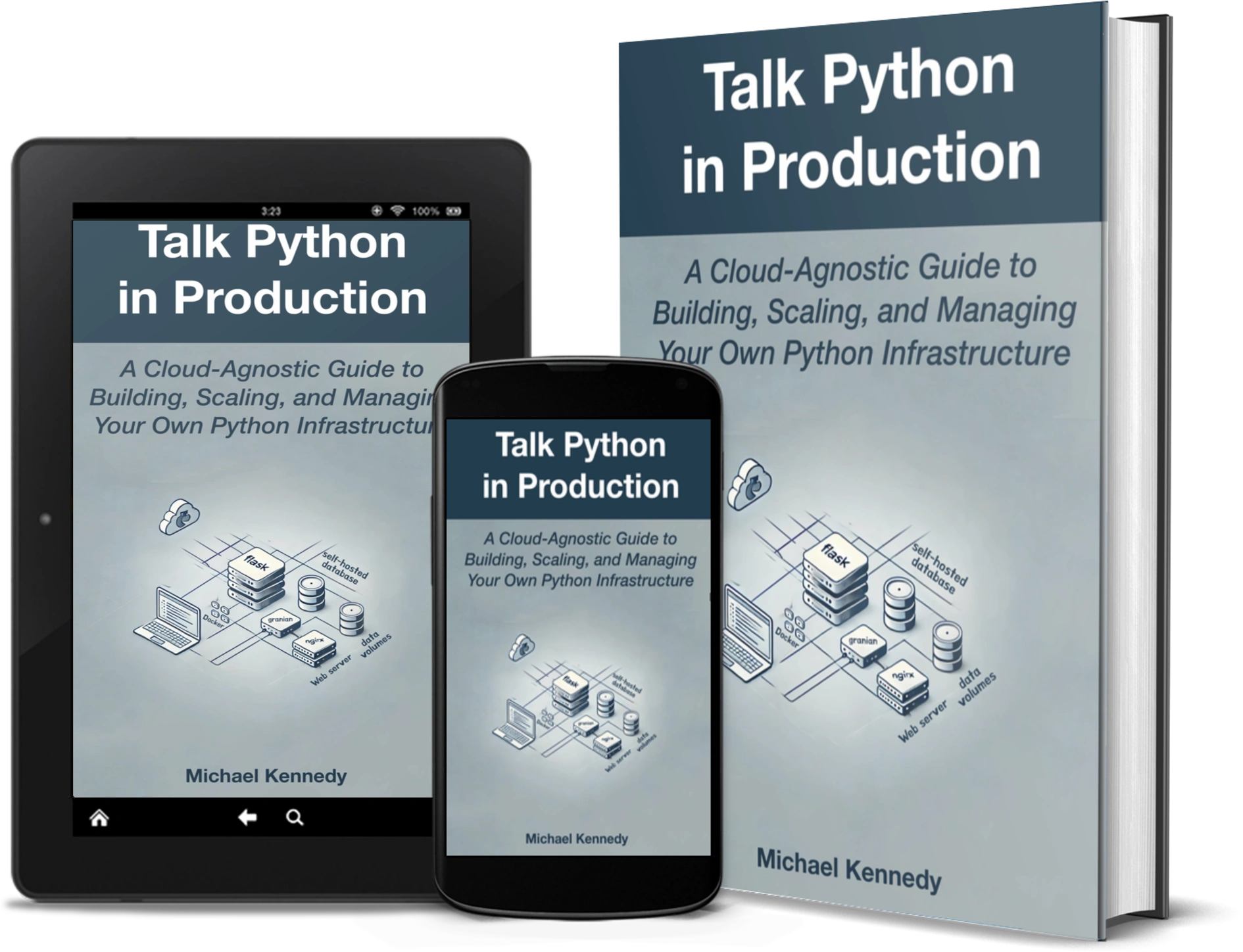
From the creator of Talk Python
Python for Production
Learn how to build, deploy, and scale production-ready Python applications. From best practices to real-world patterns, this book covers everything you need to take your Python projects from prototype to production.
Wondering if we cover a topic?
Search across 565+ episodes to find exactly what you're looking for.
Search episodesTalk Python for your AI tools
565+ episodes, full transcripts, guests, and courses are available as live, structured data. Ask your AI assistant about the show, or pull it straight into your terminal and scripts.
MCP Server
Connect Claude, Cursor, or any MCP client to
talkpython.fm/api/mcp and get 12 tools
for searching episodes, reading transcripts, and browsing courses.
https://talkpython.fm/api/mcpCommand Line
No MCP support in your AI tool? The Talk Python CLI does the same job from a terminal, with text, JSON, or Markdown output ready to pipe into anything.
uv tool install talk-python-cli
talkpython episodes search "FastAPI"
Python Bytes Podcast
Do you enjoy Talk Python To Me? We created a second podcast to be the perfect counterpart to the long-form interview format.
Python Bytes delivers Python headlines directly to your earbuds in just 15-20 minutes per week. The topical items of the Python ecosystem, condensed and ready to go.

About the Show
Talk Python to Me is a weekly podcast for Python developers, data scientists, and AI builders. Each episode features a casual 1-hour conversation with the people building the tools you use.
Have feedback for the show? We'd love to hear from you.
Suggest a show or guest
We are always on the look out for exciting topics to bring to you on Talk Python To Me. Do you have a great idea for a show? Know a dynamic Python personality who we should be speaking to?