Updates from Talk Python - March 2026
, 6 min readThere have been a bunch of changes to make the podcast and courses at Talk Python just a little bit better. And I wrote a few interesting articles that might pique your interest. So I thought it was time to send you all a quick little update and let you know what’s new and improved.
Talk Python Courses
Account Dashboard for courses
I spoke to a lot of users who said that it’s a bit difficult to jump back into your account and see which courses you were last taking. I can certainly appreciate that, especially if you have the bundle with every class is available. So I added this cool new dashboard that sorts and displays your progress through your most recent course activity as well as courses that you have finished.
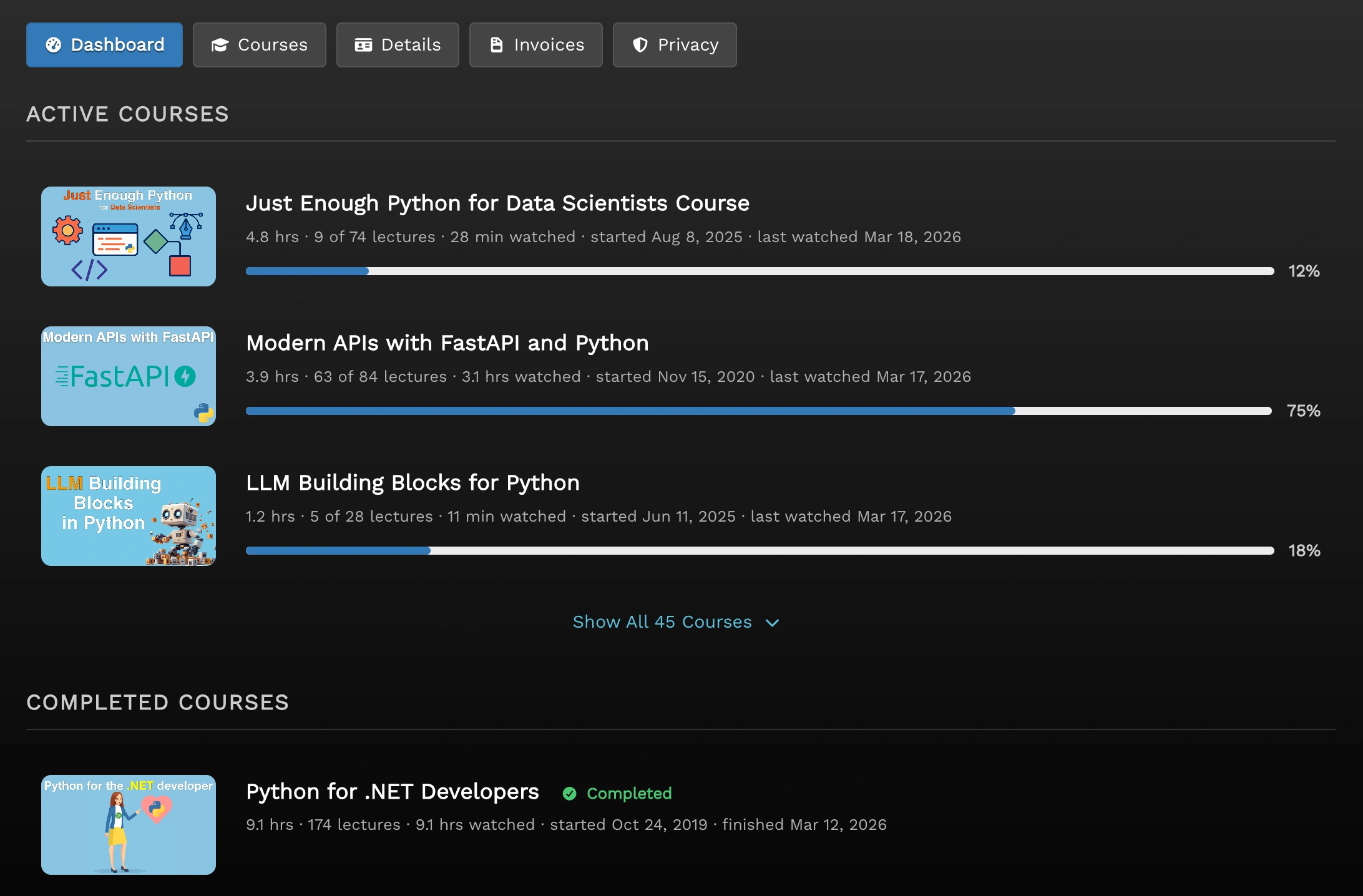
Some of our corporate users also use this for certificate or credential information where they need to know when they started and finished a course. By the way, official certificates are on the TODO list as well.
Log into your account over at Talk Python Training if a) you have one and b) you want to check out this new dashboard. :)
Volume on video player
While it’s something I never use, a lot of people have asked for a volume control directly in the web video player for the course. If you’re among those people, you now have a volume slider / hotkey right in the video player.
New course inbound
I’m working on a new course for Python web app security + agentic AI. Security has always been a sensitive issue if you’re running anything that runs on the internet, web apps, APIs, etc. In this age of agentic AI, it’s even more critical. Attackers can trivially use tools like Claude Code and other specialized AIs to search for vulnerabilities. Yet at the same time, builders like us should be taking advantage of agentic AI to secure our applications before we even publish them to the Internet. Historically, this took tens of thousands of dollars and a pen-testing consulting team. Now it’s a few hours and a few dollars. The goal of this course is to show you both sides of that coin and exactly how to get the most out of it. Look for that in the coming weeks.
Talk Python Podcast
CLI and MCP server
I’m always looking for ways to make Talk Python’s podcast content more broadly available. Recently, I added two new features or services to the podcast to make its integration with AI much deeper.
The first is a new MCP server. Find it at talkpython.fm/ai-integration and read about integrating it on our blog. If you’re working with conversational AI or agentic programming that could use access to the 7.5 million words and 11 years of content at Talk Python, and it supports an MCP server, consider adding our server. It’s free and open to use.
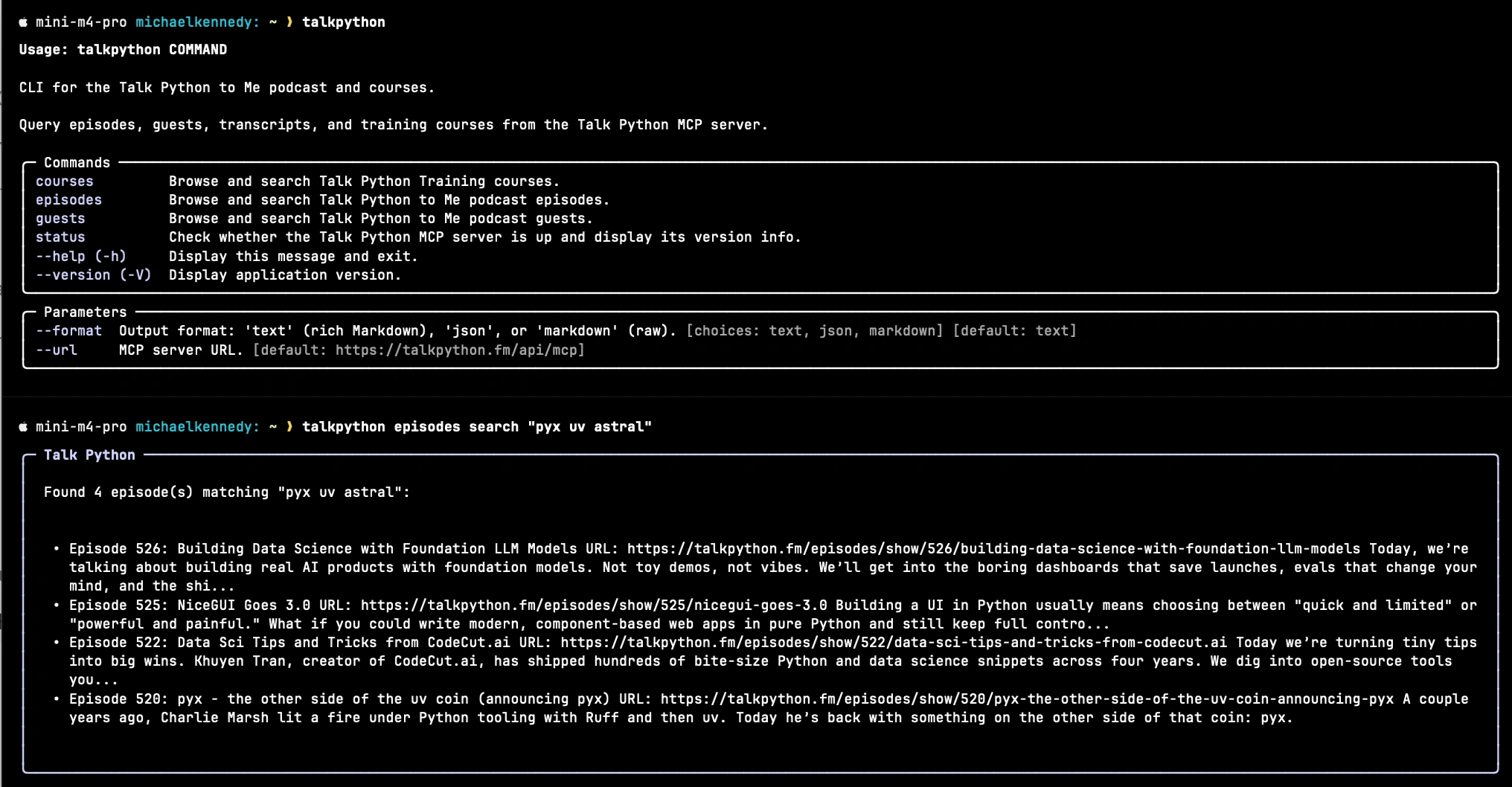
However, many AIs don’t use MCP servers or they don’t thrive with them. And you might not be an AI at all. You might just be a regular program or user that wants to access this data. For that, I’ve also created a CLI for Talk Python.
Here’s a search that is timely given the news of the week.
Robyn web framework experiments
The Robyn web framework is a very interesting Rust-based, Flask-like framework. I started thinking about what it would look like if almost all of the web framework powering the Talk Python web apps and APIs was Rust-based. My research led me to Robyn, and so I did a little feature spike exploration converting one of our web apps entirely to Robyn.
Along the way, I needed something to render Chameleon templates, my favorite Python templating language. So, I also created the Chameleon Robyn packagealong the way. All of you Robyn folks out there who were hoping for templating language choices, there you go.
It turns out, however, that even though the benchmarks show Robyn is 25 times faster than Quart (which powers Talk Python), there weren’t many practical benefits and there were some tangible drawbacks. Here’s a fun write-up on that whole process.
Replacing Flask with Robyn wasn’t worth it
Applied Raw+DC pattern plus DevOps to save 60% mem usage
I’ve been thinking a lot about frameworks and packages in general. And how the age of agentic AI means we’re probably going to use fewer packages and they’re going to be bigger rather than a bunch of small ones. Maybe the days of left-pad are behind us. ;)
In particular, I’ve been speculating that choosing vanilla options such as the most popular frameworks such as Django or Flask and using native query languages, SQL and others, are better abstractions for agentic AI even if they are not as good abstractions as ORMs are for developers.
I wrote a whole article on it called Raw+DC: The ORM pattern of 2026?
I decided to put this to the test and converted both talkpython.fm and pythonbytes.fm to use this design pattern. While those are both big projects, it didn’t take too long. And, it came out really well. As far as I can tell, Raw+DC has both significantly lowered the memory usage and given us about a 10% performance boost at the same time. Those are both awesome changes. But if I’m right about this agentic AI vanilla concept, it also means better plasticity in the future.
Will AI Kill Open Source?
A couple of the conversations around my Raw+DC pattern led to the question of whether AI will kill open source. It’s a good question. So Paul Everett and I decided to put together a video debating this very question. It’s pretty short at 20 minutes. Give it a watch if that sounds interesting.
What hyper-personal software looks like
Final thing I want to highlight is an article that I wrote called What hyper-personal software looks like. There’s been a lot of debate about whether agentic AI is good or bad for productivity. If it makes people faster or slower. I’ve posited that a lot of this is hard to measure because many people are using AI to generate what I call dark matter software. That’s software that you create just for you, and it’s probably something you never would have taken the time to create, but because that effort went from weeks to hours, it all of a sudden was a great idea.
My post dives into a real world example of exactly what this looks like and how beneficial it can be.
Thanks
That’s it for this installment. Thanks for being part of the Talk Python community. Hopefully you found some interesting things in this email. Cheers, Michael.