Audit Your Python App Like Mozilla Audited Firefox
, 3 min readEarlier this year, Mozilla announced that they had pointed Claude at the Firefox JavaScript runtime. The agent surfaced more than 100 bugs, 14 of them serious enough to become CVEs. That is the kind of result you used to only get from an expensive pen-testing engagement, and even then it would take weeks. Reading that announcement, I kept circling back to one question: could a working Python web developer pull off the same kind of audit on their own app, without a security firm on retainer and without spending pen-testing-firm money? I built a course to answer that, and the short answer is yes.
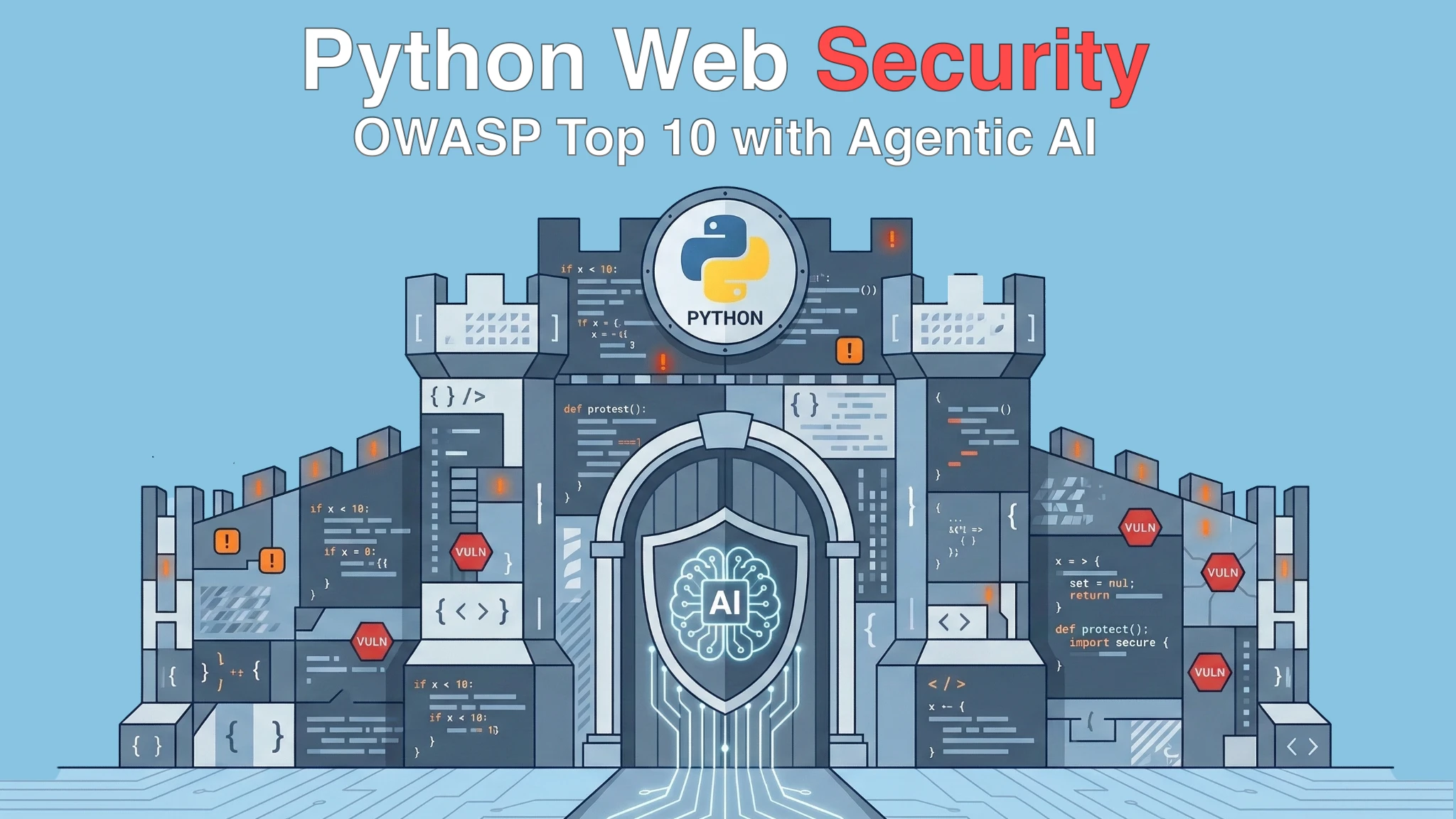
The course is called Python Web Security: The OWASP Top 10 with Agentic AI, and it is structured as a play in three acts. Act one walks every category of the brand-new OWASP Top 10 for 2025, including the “mishandling of exceptional conditions” category that did not exist on the 2021 list. Each category gets the same treatment: read the OWASP definition, look at a believable real-world scenario, see the vulnerable code, understand why it is dangerous, then see the secure fix. The samples span Flask, Django, and FastAPI, because the OWASP categories do not care which framework you picked, and you should not have to either.
In act two we build a custom Claude Code agent called the Security Lead, a 550-line Markdown definition tuned specifically for Python and SaaS security. It is wired to the canonical OWASP Markdown sources directly, so it cites real references rather than ones it invents, and it has explicit workflows for the patterns that bite indie SaaS builders hardest, including multi-tenant isolation, IDOR risks, cross-tenant data leaks, and security logging gaps. The agent file is yours when you finish the course. Drop it into any of your own repos and you have an OWASP-aware reviewer that lives in the codebase, never gets tired, and never skips a step.
In act three we turn the Security Lead loose on three real open source Python web apps, live and unscripted: Kibitzr, Paperless-ngx, and Apache Superset. I picked the projects, ran the agent on camera, and we look at what it found together. Nothing was rehearsed, and you can watch the cost meter tick along with me. The headline number: a deep review of roughly a million lines of Python cost between $3 and $5 in Claude compute. About the price of a fancy coffee. The kind of work that used to mean a five-figure pen-testing quote now fits in an evening and a lunch budget.
If you ship Python to production, you have probably had that quiet unease from what might be lurking in your code. This course turns that worry into a concrete remedy: a workflow, a reusable agent, and a clear sense of where your real gaps are. You will not get to 100% certainty (nobody does), but you will be substantially safer than you are today, and you will know exactly what you still need to fix. Take the course. If it is not the right fit, our 15-day refund is no-forms, no-hassle.